
June 201811 min read
Money-Saving Tips for Traveling With a Credit Card
In short
Credit cards are usually the cheapest way to pay for purchases abroad, but five separate fees can eat into that advantage if you're not careful. This guide breaks down each fee with a real bank statement as an example, and compares the Canadian credit cards, like the Scotiabank Passport Visa Infinite, that waive foreign transaction fees entirely.
Paying with a credit card is usually the cheapest and most flexible way to access your money abroad — but 5 different fees can apply to a single transaction, and they’re easy to overlook. When traveling, there are plenty of ways to save dozens, sometimes hundreds, of dollars on flights and hotels. Saving money on foreign bank transaction fees gets a lot less attention, which is a mistake: those fees add up fast.
Don’t get fooled: even when a currency exchange office or a financial institution advertises “no commission fees” on conversions, it just means their fee is baked into the rate. When it sounds too good to be true, it usually is — a bit like a car dealership advertising 0% financing while staying quiet about the $3,000 you’d save by not using their financing plan.
Debit cards aren’t as widely accepted abroad, and exchanging cash at your bank before departure or at a currency exchange counter on arrival is rarely a good deal. I recommend treating both as a last resort.
Credit Card Fees Abroad: What You’re Actually Paying
The 5 Possible Fees on a Foreign Transaction
A credit card transaction abroad can carry up to 5 separate fees:
1. Cash advance fee: charged any time you withdraw cash from an ATM abroad, usually between $2.75 and $7.50. It can be fixed, variable, or both — for example, 1% of the withdrawal with a $7.50 minimum.
2. Foreign exchange transaction fee: often called a currency conversion mark-up, this fee is charged by the card issuer. It’s usually 2.5% of the transaction, but can vary from 0 to 5%.
3. The interchange fee: this is the cut taken by Visa, Mastercard or American Express — or whichever payment network your card runs on. It varies enormously, as shown further down. You can check the Visa and Mastercard interchange rate for a given date.
4. Interest on cash advances: the grace period your bank normally grants doesn’t apply to a cash withdrawal, in Canada or abroad. This fee follows the card’s interest rate, usually 20-30% a year.
5. The ATM owner’s fee: charged by the bank or company that owns the machine you’re withdrawing from, usually around $4.
Paying by Card Abroad
When you pay with your card abroad, you’ll pay the foreign exchange and interchange fees, adding up to roughly 3.5% of the transaction.
| Purchase Sum (in CAD) | Foreign exchange fee | Interchange fee | Total fee | Cost of purchase |
|---|---|---|---|---|
| 10.00 | 0.25 | 0.10 | 0.35 | 10.35 |
| 100.00 | 2.50 | 1.00 | 3.50 | 103.50 |
| 500.00 | 12.50 | 5.00 | 17.50 | 517.50 |
| 1000.00 | 25.00 | 10.00 | 35.00 | 1035.00 |
Withdrawing Cash From an ATM
Withdrawing cash abroad can trigger all 5 fees above. The figures below assume a conservative scenario: a card that charges 1% of the withdrawal with a $7.50 minimum, a 2.5% exchange fee, and an ATM that charges $4 per withdrawal.
| Amount withdrawn | Cash advance fee | Foreign exchange fee | Interchange fee | ATM fee | Total fees | Withdrawal cost |
|---|---|---|---|---|---|---|
| 10.00 | 7.50 | 0.25 | 0.10 | 4.00 | 11.85 | 21.85 |
| 100.00 | 7.50 | 2.50 | 1.00 | 4.00 | 15.00 | 115.00 |
| 500.00 | 7.50 | 12.50 | 5.00 | 4.00 | 29.00 | 529.00 |
| 1000.00 | 10.00 | 25.00 | 10.00 | 4.00 | 49.00 | 1049.00 |
You can’t fully escape banking fees. A small withdrawal is hit hardest by the cash advance and ATM fees, while a larger one is dominated by the foreign exchange and interchange fees.
Interest isn’t shown in the table above, but for transparency: on a card with a 20% annual rate, a $1,000 withdrawal refunded 30 days later would cost you about $17 in interest.
A Real Example: My Bank Statement
Here’s a bank statement for a withdrawal of 500 USD I made on July 29, 2017, with my Visa Amazon card.
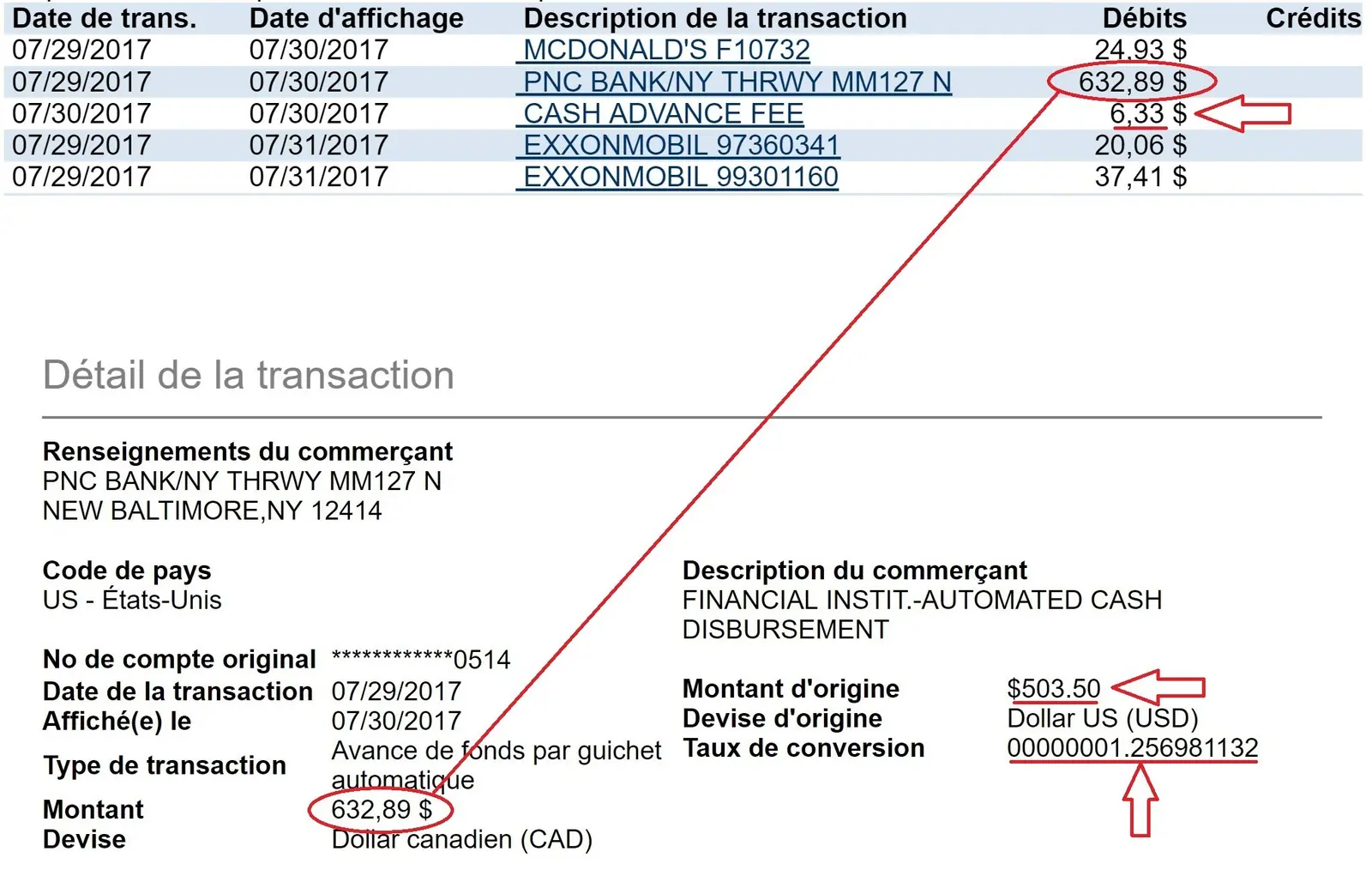
Two transactions show up on the account. The first is the 500 USD plus a 3.50 USD ATM fee; 632.89 CAD is the result of converting that 503.50 USD. The second, 6.33 CAD, is the cash advance fee charged by my bank, Chase Canada — 1% of the amount in CAD. The 1.25698 conversion rate is Visa’s rate on the day of the withdrawal, since my Amazon Visa card didn’t charge a conversion fee at the time.
For reference, the real market rate on Saturday, July 29, 2017, was 1.2432 (Friday’s closing rate). So Visa took about 1.1% as an interchange fee on that transaction.
In total, my 500 USD withdrawal cost 639.22 CAD, including 17.62 CAD in bank fees:
- 4.40 CAD ATM withdrawal fee (3.5 x 1.25698);
- 6.33 CAD cash advance fee;
- 6.89 CAD Visa interchange fee ((1.25698 – 1.2432) x 500);
- 0 CAD foreign transaction fee;
- 0 CAD interest fees.
Fees made up “only” 2.76% of the total (17.62/639.22). I got that rate down thanks to two things:
- You can avoid interest on a cash advance by pre-paying your credit card, so your account stays in positive balance after the withdrawal.
- I saved 2.5% on foreign exchange fees because the Visa Amazon card didn’t charge any — a saving of 500 x 1.2432 x 0.025 = 15.54 CAD.
The Visa Amazon card, which used to cut my foreign fees roughly in half, no longer exists. But a newer option from Scotiabank picks up where it left off: it also charges no foreign exchange fee.
The Scotiabank Passport Visa Infinite Credit Card
Card Overview
At the time of writing, this is by far the best Canadian credit card available to Quebecers for saving money on transaction fees abroad.
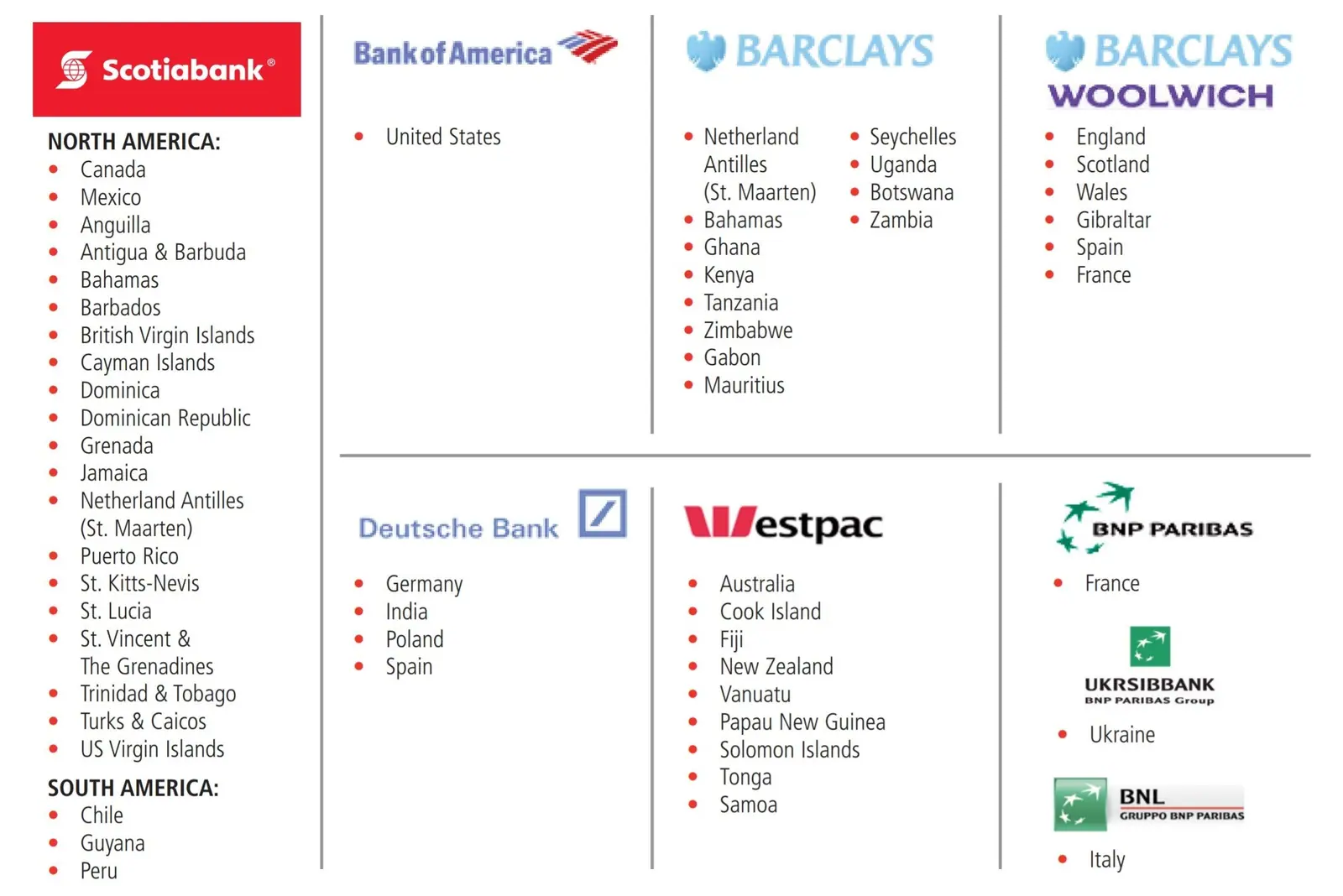
Abroad, there’s a fixed cash advance fee of $7.50 per withdrawal, regardless of the bank. But if you withdraw from a Global ATM Alliance machine, that fee drops to $3.50. Here’s the list of Global ATM Alliance banks by country.
The card costs $139 a year, but you get 35,000 bonus points for spending $1,000 in regular purchases in the first 3 months. Those points are worth $350 toward travel expenses, so you can think of the card as already paid for its first two years.
At the time, there was also a promotional offer waiving the annual fee for the first year.
Beyond a full suite of insurance, it comes with frequent-flyer perks like 6 lounge visits a year at Priority Pass airport lounges worldwide.
2026 update: the Passport Visa Infinite’s regular annual fee is now $150 (up from $139), and its complimentary lounge visits now run through the Visa Airport Companion Program rather than Priority Pass. It still charges no foreign transaction fee (source).
How Much Could It Save You?
To be clear: this card doesn’t spare you from cash advance fees, Visa interchange fees, or ATM fees. Its real advantage is that it skips the foreign exchange transaction fee altogether, while most other cards charge 2.5% — usually about half the total fee on a foreign purchase.
The table below shows how much you’d save per amount spent abroad, at $2.50 per $100. The break-even point where the card “pays for itself” is $5,560 spent per year, not counting other perks like the bonus points.
| Total spent | Total saved |
|---|---|
| 100.00 | 2.50 |
| 1000.00 | 25.00 |
| 5000.00 | 125.00 |
| 5560.00 | 139.00 |
| 10000.00 | 250.00 |
| 50000.00 | 1250.00 |
Read our world-trip organization report to see how the Scotiabank Passport Visa Infinite saved us more than $2,000 in foreign exchange fees, on top of the 72,000 points we earned on our spending — worth $720.
What About Visa’s Interchange Fee?
I had some fun calculating Visa’s interchange fee on flight tickets I’d recently bought in 7 different currencies.
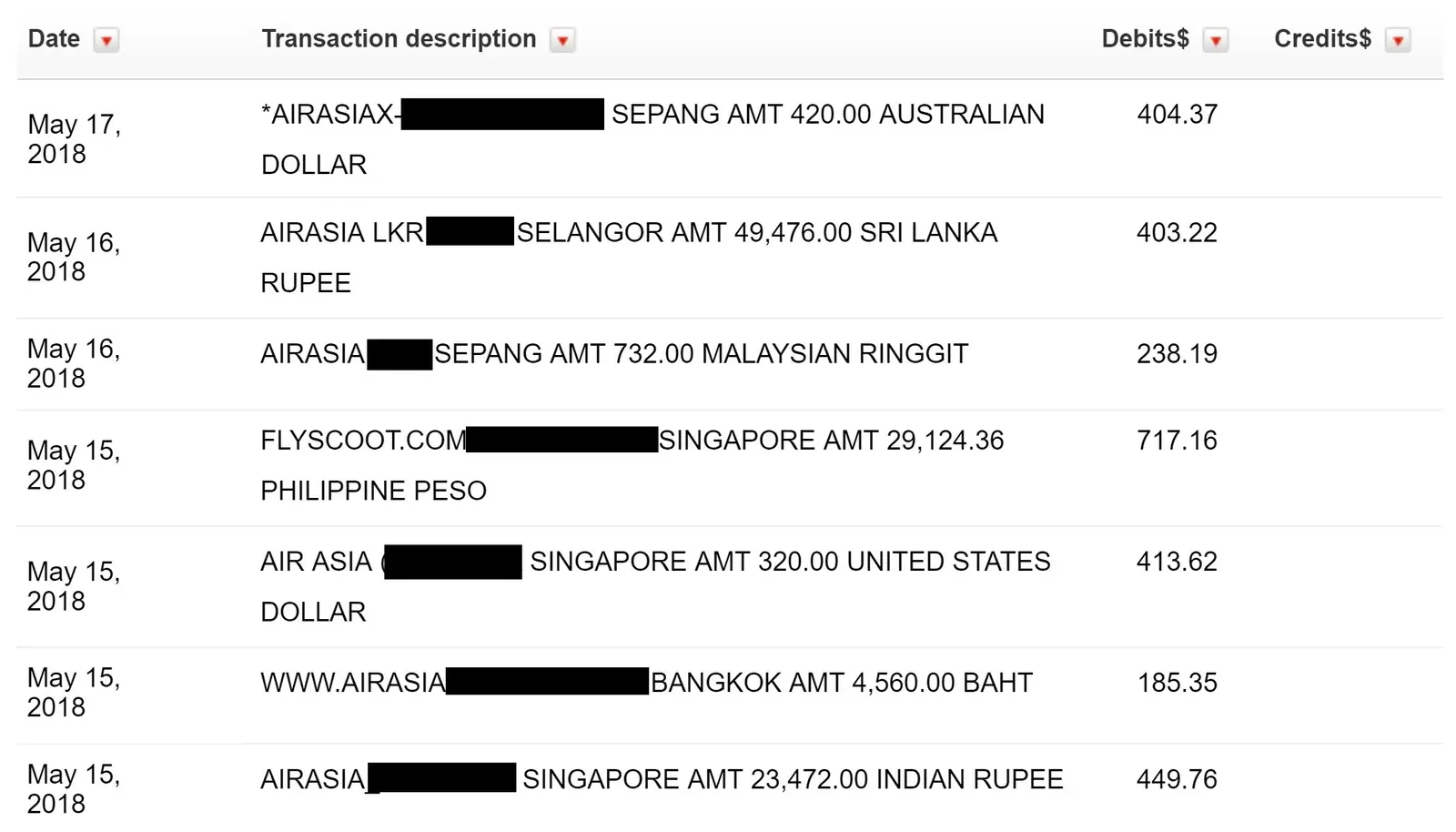
For each transaction, I calculated Visa’s applied rate by dividing the amount in local currency by the cost in CAD, then compared it to that day’s average market rate (found online) to work out the interchange fee, in CAD and as a percentage. Here’s the table.
| Date | Amount in local currency | Currency | Amount charged (CAD) | Visa’s rate | Average rate of the day | Visa’s charge (CAD) | Interchange fee (CAD) | Interchange fee (%) |
|---|---|---|---|---|---|---|---|---|
| 2018-07-17 | 420 | AUD | 404.37 | 0.962785714 | 0.96208 | 404.07 | 0.30 | 0.073353 |
| 2018-07-16 | 49476 | LKR | 403.22 | 0.00814981 | 0.008111 | 401.30 | 1.92 | 0.478486 |
| 2018-07-16 | 732 | MYR | 238.19 | 0.325396175 | 0.323315 | 236.67 | 1.52 | 0.643699 |
| 2018-07-15 | 29124.36 | PHP | 717.16 | 0.02462406 | 0.024494 | 713.37 | 3.79 | 0.530989 |
| 2018-07-15 | 320 | USD | 413.63 | 1.29259375 | 1.286798 | 411.78 | 1.85 | 0.450401 |
| 2018-07-15 | 4560 | THB | 185.35 | 0.04064693 | 0.04005 | 182.63 | 2.72 | 1.490461 |
| 2018-07-15 | 23472 | INR | 449.76 | 0.019161554 | 0.018854 | 442.54 | 7.22 | 1.631241 |
The interchange rate ranged from 0.07% to 1.63% — a big spread. My early guess was that Visa bases its rate on the day following the transaction, but even accounting for that, the numbers still look inconsistent. All I can say for sure is that Visa’s (and presumably Mastercard’s) rate seems to depend on the currency, the country, or even the merchant. If you know the actual formula, I’d love to hear it.
The two cards in detail
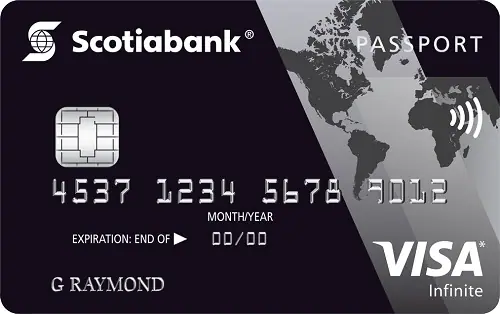
Scotiabank Passport Visa Infinite Card
Signup bonus (first year): up to 35,000 bonus Scene+ Points ($350 towards travel)
- 25,000 bonus Scene+ Points when you spend $1,000 in the first 3 months;
- 10,000 bonus Scene+ Points when you spend at least $40,000 annually on your account.
Annual fee: no annual fee on the first year (usually $139)
Earning rate:
- 5X Scene+ Points per dollar spent on travel for the first 3 months (up to $2,500 in total travel purchases);
- 2X Scene+ Points per dollar spent on transit, groceries, dining, and entertainment;
- 1X Scene+ Point per dollar spent on all other purchases.
Perks & benefits:
- No foreign transaction fees;
- 6 Complimentary Priority Pass Airport Lounge Access per year;
- Complimentary Avis® Preferred Plus membership.
Insurance:
- Travel Emergency Medical Insurance;
- Trip Cancellation / Trip Interruption Insurance;
- Flight Delay Insurance;
- Delayed and Lost Baggage Insurance;
- Rental Car Collision Loss/Damage Insurance;
- Hotel/Motel Burglary Insurance;
- Travel Accident Insurance;
- Purchase Security & Extended Warranty Protection;
- Price Protection Service.
I’ll also mention the Scotiabank Gold American Express Card. Like the Visa Infinite, it charges no foreign exchange fee. Its welcome bonus is a bit lower, but so is its annual fee, and it earns 5 points per dollar on groceries, restaurants and entertainment — which can make it the better fit for some spending patterns.
At the time, this card also had a promotional offer waiving the annual fee for the first year.
Scotiabank Gold American Express Card
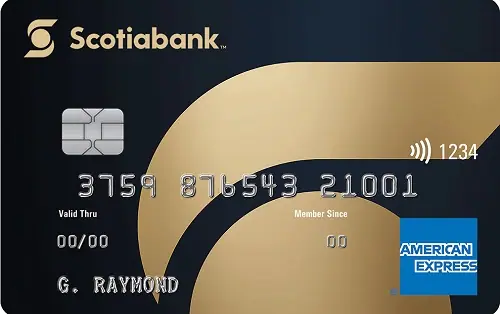
Signup bonus (first year): up to 45,000 bonus Scene+ Points ($450 towards travel)
- 25,000 bonus Scene+ Points when you spend $1,000 in the first 3 months;
- 20,000 bonus Scene+ Points points when you spend at least $7,500 annually on your account.
Annual fee: no annual fee in the first year (usually $120)
Earning rate:
- 5X Scene+ Points per dollar spent on groceries, dining and entertainment;
- 3X Scene+ Points per dollar spent on gas stations, daily transit, and select streaming services;
- 1X Scene+ Point per dollar spent on all other purchases.
Perks & benefits:
- No foreign transaction fees;
- Amex Front Of the Line;
- Complimentary concierge services.
Insurance:
- Travel Emergency Medical Insurance;
- Trip Cancellation / Trip Interruption Insurance;
- Flight Delay Insurance;
- Delayed and Lost Baggage Insurance;
- Rental Car Collision Loss/Damage Insurance;
- Hotel/Motel Burglary Insurance;
- Travel Accident Insurance;
- Purchase Security & Extended Warranty Protection.
Our Tips for Traveling With a Credit Card
To Save Money
If you plan to withdraw money in local currency, avoid interest on cash advances by pre-paying your credit card before you travel. Work out the payment needed so your balance stays positive, covering everything you plan to withdraw and spend on the trip.
You can minimize cash advance and ATM fees by withdrawing from a branch linked to your own financial institution. Check the terms your card issuer offers for this.
Pay by card as much as you can. If you do need cash, avoid small withdrawals — take out roughly what you’ll use for the whole stay. Any leftover foreign currency can simply be exchanged for “smalls” at the airport on your way out.
Before You Leave
Tell your credit card provider you’re traveling, with your trip dates. Otherwise your card could get blocked as a fraud precaution. I recommend this even if your bank’s fraud detection is excellent.
Scan both sides of your card with your phone. It’ll make dealing with a lost or stolen card much easier.
Set your PIN to 4 digits. Some countries don’t accept 5-digit PINs.
During Your Trip
Travel with at least 2 cards from 2 different networks (Mastercard and Visa, for example). If one doesn’t work, you have a backup.
When withdrawing cash, use ATMs at major banks in the country you’re visiting, ideally ones inside a bank branch rather than exposed on the street. If you have no choice, have a travel companion keep watch while you withdraw.
In a developing country, carry some US dollars. They’re accepted almost everywhere and can help in a tight spot.
In places with a higher risk of fraud or card cloning, pay cash instead of using your card. Smaller, informal transactions tend to carry more risk than larger ones — a few simple habits can save you a lot of trouble.
Conclusion
The golden rule with credit cards is to always pay off the full balance before the due date, to avoid interest. A credit card works best as a payment method, like debit or cash — not as a way to spend money you don’t have. Once you’ve got that down, you’re probably ready to try travel hacking (see Travel Hacking 101 and Travel Hacking 102) and put your credit card’s perks to work. And if you want to go deeper on Canadian credit cards, Milesopedia is a great place to keep learning.
Questions travellers ask
What fees do you pay when using a credit card abroad?
Up to 5 fees: a cash advance fee (usually $2.75-$7.50) on ATM withdrawals, a foreign exchange transaction fee (0-5%, typically 2.5%), the card network's interchange fee, interest on cash advances (20-30% annually), and the ATM owner's fee (around $4).
Which Canadian credit cards have no foreign transaction fees?
The Scotiabank Passport Visa Infinite and the Scotiabank Gold American Express are two Canadian cards that don't charge the usual 2.5% foreign exchange transaction fee, though you still pay the network's interchange fee.
How can I avoid interest fees on cash advances abroad?
Pre-pay your credit card before you travel so your account carries a positive balance at least equal to what you plan to withdraw and spend. That way, any ATM withdrawal is covered by your own credit, not a cash advance that accrues interest.
How much can a no-foreign-transaction-fee card save you?
At the standard 2.5% markup, the saving is $2.50 per $100 spent abroad, or $25 per $1,000. For an average family travel budget, this can add up to hundreds of dollars per trip.
Should I travel with more than one credit card?
Yes, travel with at least 2 cards from 2 different networks (for example Mastercard and Visa), so you have a backup if one card is refused, blocked or lost.