
October 201962 min read
Climate Hysteria, Ecological Dictatorship and the Inconvenient Truth
In short
In this opinion piece, written in 2019 after our round-the-world trip by plane, the author argues that radical environmentalism is a political ideology tied to socialism, that human responsibility for global warming has not been demonstrated and that the scientific consensus is exploited by politics, the media and education. While saying he leaves room for doubt, he calls for tolerance and open debate between the two camps.
Today I am exercising my right to freedom of expression to add my two cents on a subject that is currently stirring controversy across the Western world. I am talking about environmentalism, the political ideology that has been raised to the rank of a new paradigm.
Let’s be clear: I do not question the need to protect our environments from degradation, overexploitation, deforestation and pollution. I only take issue with the radical fringe of an ecocentric school of thought that holds humans guilty of global warming.
To give you some context, this year we completed a family trip around the world, which allowed us to visit 50 countries in 14 and a half months. Travelling at such a pace would not have been possible without flying. And we flew no fewer than 56 times.
What was bound to happen happened. We were bombarded with criticism by people for whom our way of travelling does not match their ideals. We were told that our carbon footprint is colossal and that we should have given priority to greener means of transport. We were also called reckless, selfish, individualistic, callous, even criminals and planet killers. A minority went as far as hoping that, statistically, a plane crash would be part of the trip.
Please note that this text is particularly long, because I lay out my convictions through a logical line of reasoning. You can jump directly to the sections that interest you using the table of contents. But keep in mind that each of my statements is made within a context of values and perceptions that are my own, which I explain in detail in the first sections of the text and which may help you better understand my conclusions.
Introduction
With this opinion piece, I therefore aim to express my line of thinking by setting out my beliefs and the reasons behind them. And since convictions are shaped by a set of values, principles and pretexts, I have made a point of gathering as many elements as possible to support my reasoning. That is why we will cover subjects as varied as psychology, sociology, philosophy, politics, science and religion. Because ecology does indeed transcend all these subjects!
This piece is likely to draw a flood of criticism. From the outset, I want to point out that my argument contains many generalizations and cause-and-effect links that may seem dubious to some. Most of you will also feel targeted by some of my remarks, and I apologize in advance.
My goal is obviously not to attack any particular systems of thought, bodies of theory or people, but rather to call for tolerance, through an awareness – and possibly a questioning – of the environments in which we live and which affect our intellectual and moral abilities!
My demonstration is not infallible. But I see myself as a seeker of truth. So if you think I am wrong, I am open to debate. And if you have an alternative to my opinion, I am more than willing to be convinced, but please use logical reasoning.
The Sociological Context of the Ecological Debate
Every Person Has a Cultural Iceberg
Have you ever wondered what you would have become if you had been born in another country? If you had a different skin color? If your parents had instilled a different religion in you? If you had grown up in a different environment? If you had chosen different friends?
Would you have had the same values as today? Would you have had the same priorities? Would you have made the same life choices? Would you have thought the same way? Would you have had the same convictions? Could you have been a better person? Would you have been more tolerant?
To begin with, and all the more so in the context of global warming, what better image than an iceberg to represent a person who must be convinced of the reality of climate change?
With an iceberg, the part visible above the water is in fact only a small piece of a much larger whole. Likewise, we tend to think of a group’s culture as its many observable features, that is, its cuisine, its dances, its music or its arts. But these are only the outward expression of a culture that runs much deeper.
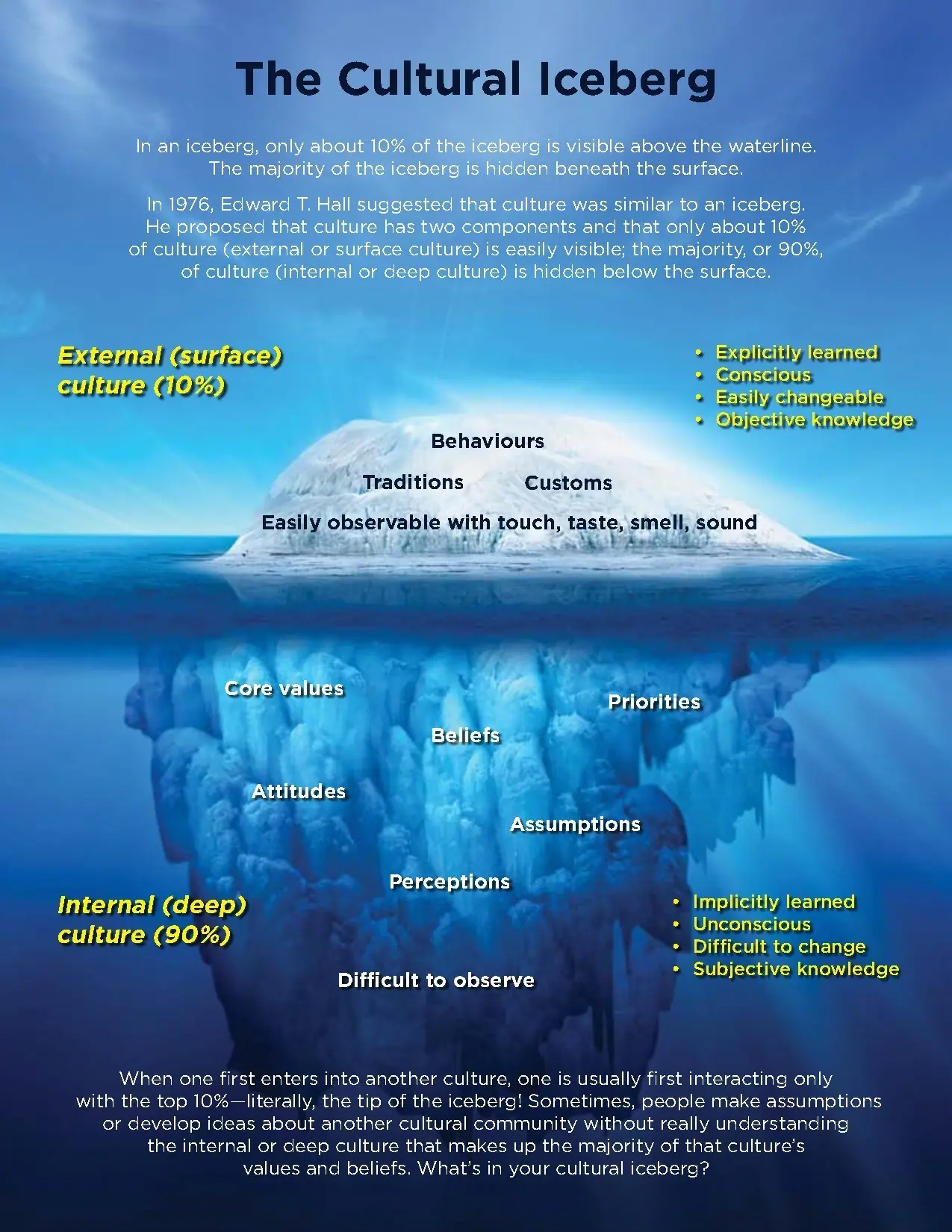
As we grew up, we all inherited or developed our own identity, customs, upbringing, principles and perceptions. From a very young age, our subconscious tells us what is good and bad, what is right and wrong, what is acceptable and what is not. Our relationships and our life choices constantly shape the reality we cultivate in our own environment. Naturally, if we expose ourselves perpetually and repeatedly to the same environment, we forge beliefs, convictions and a way of thinking which, in turn, drive our opinions, our attitude, our course of action and our behavior.
Knowledge of the Truth Is Relative
One of the most prevalent and harmful aspects of our culture is the need to be right. Yet knowledge of the truth is at once relatively absolute to oneself and absolutely relative to others. Just as there is no accounting for taste, there is no accounting for truth. But what about the real truth? Even if our relative truth is the absolute truth, that does not give us the right to think we are better than others, let alone the power to bludgeon populations and hope that, through sheer mass effect, as many people as possible will adopt our ideas, principles, values, beliefs and ideals without asking questions.
We all proudly defend our own reality, dearly acquired since birth. The difficulties we have faced throughout our lives have forged our character, our personality, our strengths. We all consider ourselves good people because we have done our best to get where we are. If our life is a failure, it is not our fault, but that of others. If our message has not come across well, it is not because our message is bad, but because others do not understand it.
Whatever our background, we are proud of who we have become because we all consider ourselves good people. We compare ourselves with others and convince ourselves that we are better than them. Our health care system is the best, our education system is the best, our history is the best, our cuisine is the best, our industries are the best. We have nothing to learn from others, but everything to teach them.
This is how the world thinks. This is how intolerance is born.
Open-Mindedness and Tolerance Are Not Natural Values
All the information we receive runs up against our cultural iceberg. We filter all information through our reasoning system, which is made up of our values, our principles, our beliefs, and so on.
In some countries, an individual who changes religion is a disgrace to his own family, a rebel in the eyes of society, a burden who deserves to be marginalized. This individual simply does not deserve to live. But he is seen as a hero in Western democracies.
In Western democracies, an individual who does not buy into the climate hysteria is a fool in the eyes of society, a criminal who deserves to be marginalized. This individual simply deserves to die in a plane crash. Far from being a hero, he is a zero.
Both individuals simply have the courage of their convictions. Double standards.
More often than not, our lack of open-mindedness and tolerance unconsciously pushes us to reject any discourse that does not fit our value system, without even trying to assess its quality.
So instead of trying to understand the person we are talking to, we criticize and belittle them. Out of excessive pride or for fear of seeing our cultural fortress collapse like a house of cards, we refuse to admit we are wrong. Instead of welcoming a diversity of opinions, we flee from it and try to eliminate it. In doing so, we withdraw into our values and dig in our heels.
Changing One’s Opinion Is Hard
(Un)fortunately, the iceberg tends to melt, and faster and faster as it drifts away from the pack ice. The pressure of warmer water on its sides, combined with Archimedes’ buoyancy in its depths, gradually makes its visible part disappear. These forces can be likened to collective awareness. Our environment (our relationships, our education, social media, the media, etc.) makes us aware of the issues of the society in which we move.
Starting from the premise that our world is home to 7.5 billion individuals, of all races, all religions, all cultures, all living different realities and each carrying their own baggage, convincing everyone on a subject as complex as ecology is an arduous task. What’s more, raising climate alarmism to the rank of a new paradigm worldwide, even over the span of a century, is a colossal, if not impossible, task.
Did you know? Although it is generally accepted that the Earth is round, there is a stubborn part of the population that still believes it is flat. What may seem obvious to most is not necessarily so to some. And for good reason: those who subscribe to the flat Earth theory also have reasons they describe as obvious for doing so. I want to make it clear that I personally do not subscribe to it, but I have studied its arguments and they are not as far-fetched as one might think.
To completely change an individual’s beliefs, you had better have serious arguments. The real problem is knowing whether an argument is truly serious or not. Because even if it may seem obvious to the one who believes in it, its assumptions may rest on weak foundations.
Given the complex circumstances of the subject we are dealing with, in which strong arguments exist for siding with one camp or the other, it is best to show a great deal of humility and favor dialogue. Unfortunately, confrontation is (too) often the chosen approach, at the expense of dialogue.
My Cultural Iceberg
My perception
Those who followed us during our trip have probably noticed my analytical abilities. That same analytical mind led me to pursue scientific studies and earn 6 university degrees, including a “Bachelor in Applied Physics” from the University of Portsmouth (England) and a Master’s in Electrical Engineering from Université Laval (Canada), with a concentration in radiocommunications.
Admittedly, a level of education is no guarantee of truth. And I cannot claim the authority to speak about climatology, since I know nothing about the subject. However, having spent an enormous amount of time informing myself, having fairly advanced notions in the field of science and knowing a little about the ethics of scientific research, I can say with certainty that the results of scientific research and scientific journals can be controlled by a minority of scientists, funded by lobbies, backed by the governments of this world, and who can put across whatever message they want to put across. Scientific communities can even go as far as rejecting papers that run counter to the beliefs of their sponsors.
Unlike in the days of Galileo, Copernicus, Newton, Kepler, Foucault or Schrödinger (the latter gave me a hard time!), scientific research is no longer carried out to find new theories, but rather to support politicized ideologies. For this reason, any result that falls outside the unquestionable truths of “mainstream” scientists can be rejected, however plausible it may be. And ecology is no exception to the rule!
My reason
While everyone unsuspectingly tolerates the scientific and media bombardment, I have made a habit of never taking the information I receive for granted without questioning the accuracy of the facts reported or checking the logic behind the reasoning. That does not rule out that I may be wrong.
So I looked neutrally into the premises, principles and origins of the beliefs, not only of the alarmists, but also of the climate skeptics. I familiarized myself with the arguments of both camps by reading scientific resources from both camps and by watching debates between experts from both camps.
I realized that there is no absolute certainty that human activities are the cause of global warming. This is mainly because, contrary to what the scientific community claims, it has not been proven that anthropogenic (human-caused) CO2 has a significant influence on global warming.
My position
Between the scientific alarmists and the renowned climate skeptics, there is a crowd of people who are neither interested in nor able to spend time poring over all the literature related to environmentalism, but who have more or less clear convictions toward one camp or the other. In this respect, although I took the trouble to spend hours informing myself on this complex subject, I do not yet consider myself well-versed enough to hold a clear conviction beyond all doubt. All the more so, I do not believe that most people who campaign (or simply voice an opinion) on environmentalism are really able to grasp the scope of their actions.
That is why, even if my arguments lean in favor of the climate skeptics, I prefer to leave the door open to uncertainty. Because the truth is one thing, and my knowledge of the truth is another. This implies that the essence of rational inquiry should be intellectual humility, and that the slow and painful progress toward truth is best served by the open and honest expression of disagreement. For all these reasons, I condemn any attempt, on either side, to use political force to end academic debate.
My heritage
Personally, my iceberg and my cultural heritage have been sorely tested. My grandparents fled communist China for Cambodia, where my parents were born. When communism caught up with my family in Cambodia, my persecuted parents fled to France, where I was born. I grew up in the Taoist, Confucian and Buddhist traditions.
My youth was shaped under Mitterrand’s 14-year reign, in the middle of which I was led to believe that socialism would bring happiness to all French people. At school, I rubbed shoulders with minorities from the housing projects, of every origin, religion and tradition.
In my own country, I faced prejudice and racism. The values passed on by my parents allowed me to do well. I left France for England, then Canada, to find the opportunities I might not have had in France.
For the past few years, I have noticed that my adopted country, Canada, is showing the same signs of drift as my country of birth did in the 1980s. The progressive liberalism movement, which slowly killed France, is eating away at Canada, without its population realizing it or being able to remedy it.
My convictions
It was by leaving France for England, then Canada, and by starting to travel, that I began to realize that the fictions of George Orwell’s “1984” and André Malraux’s “Man’s Fate” (La Condition Humaine) – which I was forced to read in middle school, and I am now very glad of it – overlap with our daily reality, beyond all understanding.
I questioned the veracity of history, the sincerity of politics, the truthfulness of religions, the authenticity of our interactions, the accuracy of our science, from several perspectives. I realized that everyone is being brainwashed, and not just a little! I had to set aside my entire value system and my dogmas in an existential quest for truth. I admit that living a love story with a Mexican woman for 20 years helped a lot!
My cultural iceberg was tinged with negativity by socialism, which led me to ask myself many existential questions. In my quest to defend the most persecuted and contribute to a better world, I became the perfect example of the most condemned human being in the Western world: a Christian, conservative, capitalist, creationist, climate skeptic.
Let he who is without sin cast the first stone!
The Ideological Context of the Ecological Debate
Now that you know my cultural iceberg, you may think that my anti-socialist bias is exaggerated. That is because I have only told you about the visible tip of the ideological iceberg of socialism.
Freedom, an Illusory Concept
The relationship between freedom and democracy is described as follows:
Independently of any notion of morality or duty, which fall under other criteria of judgment, an individual is thus considered free, in a given situation of life in society, when his possibilities of action – knowing that he may decide to act or not to act – are greater than the opposing constraints he is subject to in the circumstance (social relations, moral and material necessities, requirements of the law, etc.), that is, as long as his power prevails, through its effect, over whatever (force, energy or power) may oppose him. Consequently, the recognition in law of “political and social freedoms”: freedom of conscience, of thought, of opinion, of expression, of communication of ideas, of movement of persons, of assembly, the right to strike, etc., cannot be regarded as the granting of real freedoms if the conditions are not in place for individuals to have the power to exercise them. The dynamic view of freedom implies that society gives priority to the weak, the disadvantaged, the dominated or the abused, granting them the powers they lack to rise out of their condition. It is a question of the “spirit of the laws” and of their enforcement by public authority, that they should above all have a protective or supportive side and that repression should not be their primary inspiration.
Freedom is therefore, like democracy, a matter of possessing powers, and democracy, when it is conceived not as a regime of equal rights but of maximum popular power, is then the regime of the maximum possible freedom, while ruling out that this freedom be that of “the fox in the henhouse”.
— la-democratie.fr
In other words, what rules in a democracy is not “the will of the people”, but the will of politicians, who are themselves guided by professional lobby groups, interest groups and activists. The only freedoms given to citizens are to vote and to consume.
Socialism as a Springboard to Communism
The masterminds of communism understood well how to use democracy to their advantage. And their goal has always been the same: to impoverish the people in order to grant themselves maximum power. And their tactics have never changed either:
- Weaken the rich by taxing them, demonizing them and ultimately driving them away;
- Redistribute money to the weak and disadvantaged in order to win them over and gain their votes;
- Gag the intellectuals by disparaging them in order to hide the truth from the people;
- Spread lies to the people by keeping them in ignorance;
- Pose as the saviors of the nation before the people realize the deception;
- Seize absolute power with the consent of the people;
- Establish a totalitarian communist regime;
- Purge the bourgeois, the intellectuals and all forces dissenting from the regime;
- Rule supreme over a people utterly poor and dulled.
Socialism is a soft, tolerable and even commendable form of communism, which legalizes and legitimizes the continuous plundering of the population. Once the population is well drugged, all the communists have to do is go on the attack. Venezuela is a good current example.
Bolshevism as a Model of Socialism
Does that make you laugh? Let’s review our history lessons, shall we?
At the end of the 19th century, Vladimir Ilyich Lenin joined the Russian Social Democratic Labour Party, whose split he provoked in order to found the Bolshevik party. After the collapse of tsarism, he led a socialist revolution, with the support of peasants and workers, to overthrow the bourgeoisie.
In his work “The State and Revolution”, Lenin schematically lays out the plan he undertook and carried out. He writes:
Society will first go through the “lower” phase of communist society, that is, the dictatorship of the proletariat: the overthrow of capitalism through a violent revolution will lead to this first phase, known as “socialism” or, more precisely, economic collectivism, during which the State will take possession of the means of production. During the dictatorship of the proletariat, which will help consolidate the revolution, the State will survive in the form of a “proletarian State”. The stage of socialism will involve the maintenance of a certain social inequality, but society will gradually evolve toward absolute equality, finally reaching the “higher” phase, that of full communism, which will correspond to a classless society where private property will no longer have any reason to exist; the State, having become useless, will then wither away of its own accord. Any “excesses” committed by certain people will be repressed by “the people”, who will carry out repression in place of the former State apparatus.
— Vladimir Ilyich Lenin
We know the rest of the story, with the mass extermination of the regime’s dissidents. Total number of victims: 15 million.
Nazism as a Model of Socialism
Adolf Hitler had a deep contempt for capitalism. He had joined the proletariat through the German Workers’ Party, out of which he founded the NSDAP, or National Socialist German Workers’ Party. He gained power through the democratic process, entirely legally. His popularity led him to win a plebiscite (89.93% yes) granting him absolute power. We know the rest of the story.
Hitler blamed the Jews for all of Germany’s ills and for causing its 1918 defeat (the so-called “stab-in-the-back” theory). These accusations served to justify their persecution and then their extermination.
Hitler’s plan was to control education, fight critical thinking and establish a strong central power. The Nazis are traditionally considered far-right because of their antisemitism, but they were indeed socialists in their left-leaning economics. Of course, Hitler called himself anti-communist, in opposition to his enemy Stalin, but his actions and statements did not belie his convictions:
We are socialists, we are enemies of today’s capitalistic economic system for the exploitation of the economically weak, with its unfair salaries, with its unseemly evaluation of a human being according to wealth and property instead of responsibility and performance, and we are all determined to destroy this system under all conditions.
— Adolf Hitler
Does this speech sound familiar? Total number of victims: 25 million.
Environmentalism as a Branch of Socialism
You need to step back a little (a lot) to get an overall view of the situation. This makes it possible to understand why history repeats itself, again and again, without human beings realizing it.
We know to what extent environmentalism is a concept pushed mainly by left-wing politicians. Yet it is only one element among the many ideological currents of modern socialism. I am referring in particular to (social) liberalism, (social) progressivism, humanism, feminism, veganism, environmentalism, anti-racism, and the LGBT and pro-choice movements.
These schools of thought, which are broadly left-wing, exist for fundamentally noble causes, most of them even particularly commendable, and I personally advocate a certain modernity of thought. After all, freedom of practice and opinion is a sacred feature of democracy. On the other hand, I deplore the exploitation of these causes for ideological ends.
Over time, these causes have been stripped of their original essence, not only to promote socialism, but above all to impose ideologies as a new truth in the collective consciousness, through methods with anarchist and totalitarian tendencies.
This translates into group stigmatization of minorities whose values and convictions are not in the “mainstream”, digging an ever wider gap in society, to the point where dialogue has become impossible.
Activists want to impose a uniformity of thought, creating in the process what is called a tyranny of the majority, and aiming to impose on the entire population their own belief system as the new truth, when it was once merely a marginal precept.
The Radicalism of Environmentalism
Today, and for some years now, no one can deny the exponential amplification of far-left intolerance, embodied by a rise in activism, excessive publicity by politicians and the media, and a radical change in social mores.
Ecology has become a tool of a totalitarian system in the making where, under the guise of good intentions, every aspect of individuals’ lives is meant to be formatted, standardized, normalized, where free will has a place only as long as it does not deviate from the imposed single way of thinking. This radicalization resembles a form of politically correct fascism wrapped in green to soften the appearance of a totalitarianism with communist overtones. This is not surprising, given that fascism was also inspired by socialism.
Instead of seeking a fair balance, we are witnessing a system that destroys freedom. The standardization of thought, the erasure of individual freedoms and imposed beliefs feed the base of masses who have lost their bearings, the better to indoctrinate them and turn them into happy tools of a system serving the crooked. Dream on… when you wake up, your freedoms will be nothing but a fond memory. Your lives already no longer belong to you.
Environmentalism as a Facilitator of Communism
Zuzana Janosova Den Boer, who lived in former communist Czechoslovakia before immigrating to Canada, testifies that Canada, through environmentalism, is showing all the warning signs of communism, in order to warn us of its imminent danger. She wrote the article “I survived communism. Are you ready for your turn?”, from which the following is an excerpt:
In 1972, Gus Hall, then chairman of the Communist Party USA, stipulated in his book “Ecology: Can We Survive Under Capitalism?”:
“Human society cannot basically stop the destruction of the environment under capitalism. Socialism is the only structure that makes it possible… This is true in the struggle to save the environment… We must be the organizers, the leaders of these movements. What is new, is that knowledge of [a] point-of-no-return gives this struggle an unusual urgency.”
This idea was incorporated into the US Green Party program in 1989 (the same year soviet communism collapsed), in which the fictitious threats of “global warming” and “climate change” are used to scare the public into believing humanity must “save the planet”:
“This urgency, along with other Green issues and themes it interrelates, makes confronting the greenhouse [effect] a powerful organizing tool… Survival is highly motivating, and may help us to build a mass movement that will lead to large-scale political and societal change in a very short time…
First of all, we [must] inform the public that the crisis is more immediate and severe than [they] are being told, [that] its implications are too great to wait for the universal scientific confirmation that only eco-catastrophe would establish.”Do you think the UN Intergovernmental Panel on Climate Change is promoting science rather than socialism? Read the following admission from the co-chair of the UN IPCC Working Group III, during an interview in 2010 with the Swiss newspaper Neue Zürcher Zeitung:
“We must free ourselves from the illusion that international climate policy is environmental policy… We must state clearly that we use climate policy de facto to redistribute the world’s wealth.”
— Zuzana Janosova Den Boer
Environmentalism is an ideology exploited by social democrats with the aim of bringing about communism. You have been warned.
Atheism as a Transition Factor
Have you heard of state atheism? It refers to the incorporation of atheism as the official political doctrine of a state. Few countries practice or have practiced state atheism. These countries are the former Soviet Union, China, North Korea, Vietnam, Cambodia and Cuba, and they have one thing in common that we all know. That is being communist countries. Speak of the devil!
Indeed, atheism is an essential component of Marxist-Leninist philosophical thought, which campaigns for the abolition of religion and the acceptance of atheism, calling for the establishment of a scientific materialism based on natural laws. Marxism-Leninism defines religion as “the opium of the people”, in the sense that “it promises an eternal reward after the passive acceptance of a life of suffering on Earth”.
In his “Contribution to the Critique of Hegel’s Philosophy of Right” (1843), Karl Marx writes:
Religion is the sigh of the oppressed creature, the heart of a heartless world, and the soul of soulless conditions. It is the opium of the people. The abolition of religion as the illusory happiness of the people is the demand for their real happiness. To call on them to give up their illusions about their condition is to call on them to give up a condition that requires illusions. The criticism of religion is, therefore, in embryo, the criticism of that vale of tears of which religion is the halo.
— Karl Marx
When you know that communism is the ideology of utopia and disappointment, you better understand how Karl Marx’s view of religion fits neatly into his vision.
It is also easy to understand why atheism – with secularism serving as a laxative – is hammered so hard into the minds of young schoolchildren in our Western societies with a strong socialist leaning.
Progressivism as a Substitute for Universal Morality
Without God, there is no objective morality. Good becomes evil and evil becomes good. Above all, immorality becomes progress.
The central idea of progressivism is the conviction that any morally significant change from the status quo is necessarily progress. If you disagree with the change, you are morally “backward”.
Presenting morality as a historical evolution is powerful because it puts an end to future debate. But is the status quo necessarily morally inferior to some inevitable future condition toward which we are being pushed by the mysterious force of history?
Progressivism is thus based on an absolute relativism (all civilizations, cultures and works are of equal value) and regards egalitarianism as the sole culmination of human moral history. And all those who oppose this Manichean vision are then regarded as the “bad guys”, morally contemptible. Although it is in fact a movement away from rationality, this myth of progress is passed off as common sense.
The “progressives versus conservatives” divide is openly claimed by left-wing politicians, who want to relegate conservatives to the camp of obscurantists and thus impose the “moral superiority of progressives”, in the image of their master Joseph Stalin, whom his successor Nikita Khrushchev praised as the “beacon and guide of progressive humanity”.
Evergreen, the American college with an ultraliberal and progressive tradition, makes us realize what Western societies should expect to experience if they keep giving too much room to progressivism.
Progressivism and Humanism, a Powerful Duo
Few atheists dare to say that atheism is not knowledge, but a belief. Yet to condemn or refute the existence of God is implicitly to position oneself as a believer.
Starting from the premise that God gives meaning to life, life without God becomes meaningless and absurd. The atheist faces a considerable challenge when it comes to the search for meaning in the face of the abysmal and distressing mystery of existence.
So where can meaning be found, if not in a god? In reason, logic, science, with their known limits? In material things, in possessions, through a race for success, performance, consumption? The key is not there either.
The spiritual atheist naturally turns to humanism. Failing to turn to God, man turns to man. He becomes his own god. There he finds a spirituality based on developing his personal values, through the search for, understanding and use of his inner self. In doing so, he must manage to suppress all his fears in order to face death serenely, above all in the hope of dying with dignity. If only it were that simple!
However, the atheist has no solid foundation for his convictions. In a universe without God, the atheist is like a free electron without moral dogma, searching for the meaning of life and accepting a truth relative to his perceptions.
Humanist as he is, man campaigns for the causes he considers noble, such as social injustice, inequity, inequality, cruelty, persecution.
Progressive as he is, man is quickly overtaken by perversion, corruption, immorality, greed, degradation.
The humanist and progressive atheist becomes an activist. He is ready to do anything to assert his rights, including civil disobedience and violence. The communist revolution is under way.
The Players in the Confrontation
Now that the sociological and ideological foundations have been laid, we can enter the ecological debate.
Climate Alarmists: Who Are They?
Among the followers of the climate-hysteria sect, there are 3 categories of people: the groupies, the sympathizers, the idiots.
The groupies
These are the diehards, the activists, the zealots, the saviors of humanity, those without whom we would already have seen the apocalypse. We should thank them, because thanks to them there is a debate on global warming today, but according to them there should not be one, because no challenge should be possible: man is responsible, period. They claim the science is settled and merely repeat what they have heard. In reality, they have never wondered whether their opponents could be right, because in any case everything that comes out of the latter’s mouths is false.
They are of the same ilk as those Lenin cynically called “useful idiots”, referring to Western intellectuals who, too hurried to properly analyze the consequences of their actions, unwittingly defended a cause that contradicted their deepest convictions by supporting the communists. They act in good faith, but they are easily manipulated. They shout louder than everyone else. So when it comes to destabilizing, or even humiliating, an opponent, they are very effective.
The sympathizers
This category includes most individuals in Western countries. It is made up of many wonderful people who are capable of useful conversations on the subject of climate change. These are normal people who are almost as convinced as their zealous friends, but they are not ready to let go completely without compromising their quality of life. For example, they fly with a guilty conscience, but they put things into perspective by offsetting their carbon footprint afterwards.
They are the modern Homo sapiens sapiens for whom the search for truth is not a priority. Instead of favoring their reason, they use their emotions and their survival instinct to make decisions. Their cognitive bias and their non-rational judgment join forces to affect their ability to think, short-circuiting their logical process at the same time.
Simply put, they rely on what they perceive to accept a truth or jump to conclusions.
For example: natural disasters are deadlier, the planet is warming, CO2 in the atmosphere is increasing, the world’s population is growing. Therefore, man is responsible for global warming.
Another example: science proves it, politicians assert it, the media report it, schools teach it, there is a consensus, so it is true.
The idiots
And then there are the idiots. Frankly, there is not much hope for them. If you can get the tribe they belong to to change its position, they will follow you and probably will not even realize they have changed position. They jump to conclusions even faster than their friends the sympathizers.
For example: Justin Trudeau is young, handsome and talks about ecology, so he would make a good prime minister.
Climate Skeptics: Who Are They?
Climate skeptics are first and foremost people who ask questions. They prefer to call themselves “climate realists”. They do not take for granted everything they are told and do not act on impulse, but with reason, to form an objective idea of the climate reality, unlike the alarmists, who merely spread the popular idea without knowing the other side of the coin.
Among them are scientific leaders respected in their own fields of research:
Richard S. Lindzen, an American physicist, professor emeritus of meteorology at MIT, laden with prizes and awards for his work on the atmosphere, is also the most renowned skeptic in the United States. He was one of the lead authors of chapter 7, “Physical Climate Processes and Feedbacks”, of the IPCC’s Third Assessment Report on climate change. He maintains that the science is far from settled and that “confident predictions of catastrophe are unwarranted”. In 1996, he drew an analogy between the early- and mid-20th-century consensus on eugenics and the current consensus on global warming.
John R. Christy, professor emeritus of atmospheric science and director of the Earth System Science Center at the University of Alabama, was a contributor and lead author in 5 IPCC reports related to satellite temperature records. He states: “I see neither the developing catastrophe nor the smoking gun proving that human activity is to blame for most of the warming we see. Rather, I see a reliance on climate models (useful but never “proof”) and the coincidence that changes in carbon dioxide and global temperatures have loose similarity over time”.
Judith A. Curry, professor of atmospheric science and climatologist, honored by the American Meteorological Society, the American Geophysical Union, NASA, NOAA and the National Science Foundation. She was one of the leaders of the IPCC supporters’ movement, describing herself as “the High Priestess of Global Warming”. One day she decided to engage in discussion with skeptical scientists, openly and in public, which led her to break with her convictions. She was cast out of her academic clan for publicly expressing her reservations about some of the most extreme claims made by “mainstream” climate scientists. For her, “climate science has become a political party with totalitarian tendencies” and “a dubious science serving a political project”. In 2017, she resigned from her university professorship, pointing out that a scientist is now obliged to adhere to the IPCC’s ideology and give up his scientific integrity to obtain funding and advance his career.
Patrick Moore, co-founder of Greenpeace, explains his departure by the fact that Greenpeace “took a sharp turn to the political left” and “evolved into an organization of extremism and politically motivated agendas”. He warns that anthropogenic climate change is a hoax that benefits many people, including politicians who see it as a way to win votes, green businesses, “scientists” in search of grants, and many others. According to him, “there is no scientific proof that human emissions of carbon dioxide (CO2) are the dominant cause of the minor warming of the Earth’s atmosphere over the past 100 years”. Today, Greenpeace is trying to erase the traces of its ties with Moore.
Ivar Giaever, 1973 Nobel Prize in Physics. He is particularly opposed to the misuse of ecology for political ends. He declared: “I am a skeptic. Global warming has become a new religion. We frequently hear about the number of scientists who support it. But the number is not important: only whether they are correct is important”.
Lennart O. Bengtsson, a Swedish meteorologist whose research interests include climate sensitivity, extreme events, and climate variability and predictability. He has won numerous awards in the field of meteorology. Bengtsson is best known to the general public because of a dispute that arose in 2014 over a paper that he and his colleagues had submitted to the journal Environmental Research Letters, but which was rejected for publication for what Bengtsson claims were “activist” reasons. The paper challenged the uncertainties surrounding the climate’s sensitivity to rising greenhouse gas concentrations contained in the IPCC’s Fourth and Fifth Assessment Reports.
Climate Skeptics: What Do They Believe?
What climate skeptics believe
Contrary to popular belief, climate skeptics accept that the climate is changing, that the planet is warming, and also that CO2 is a greenhouse gas.
On the other hand, the climate skeptic does not believe that man is mainly responsible for global warming, nor that global warming is destructive for mankind and the planet. If the proof were logical, demonstrated and sufficient, there would be no debate today.
In reality, the scientific debate has never been about whether global warming is real, but mostly revolves around its attribution (to man), its magnitude and its effects.
Climate change, as a global condition, is irrefutable. Paleoclimate models are extremely consistent and empirical data are abundant. On a planetary scale, there have always been climate changes and there always will be, whether anthropogenic (human-caused) or natural.
Anthropogenic global warming is probably not a myth. But the “climate crisis” certainly is. In fact, the “climate problem” does not exist. The fear of anthropogenic global warming is based on confusion and superstition, not on science.
Temperatures are not rising faster
There are many misconceptions about what the science shows. For example, it is often said that “temperatures are rising faster than ever”. In reality, everything suggests that there is nothing unusual about the modest warming the Earth has experienced in recent decades.
The fallacy that 20th-century warming was unusual and unprecedented is a product of statistical illiteracy. Paleoclimate information, inferred from indirect evidence such as marine sediments, is naturally “smoothed” by processes that blend the evidence of consecutive decades, centuries and millennia. As any engineer knows, when a graph is smoothed, sharp fluctuations disappear.
Climate alarmists apparently do not know this. They see a paleoclimate graph and say: “it took 10,000 years for the temperature to change by 3 degrees, that’s much slower than what we measured in the 20th century!” But of course, they have no way of knowing the frequency and magnitude of temperature variations during each decade of those 10,000 years.
Indeed, the climate has a range of forcings that tend to regulate it naturally. Most of these natural forcings are far more powerful than anything humanity can undertake. As an example, one need only mention the 1991 eruption of Pinatubo, which caused global temperatures to drop by 0.5 degrees for 3 years.
CO2 is not a temperature regulator
The climate is a complex, dynamic and non-linear system. There is no correlation between global temperature and the level of CO2 in the atmosphere. A system as complex as the climate cannot be assessed by the sole criterion of CO2. The climate changes rapidly and naturally in unpredictable ways.
Assuming that CO2 is the regulator of the Earth’s temperature is an easy shortcut for ignoring all the other factors influencing the climate. It is even arrogant of man to minimize the complexity of nature.
No one knows to what degree anthropogenic CO2 contributes to climate change. According to paleoclimate models, CO2 has never been correlated with the planet’s temperature over the 590 million years before our era.
Correlation and causation
It is incorrect to say that CO2 is the cause of rising temperatures for the simple reason that correlation is not necessarily causation. Causation requires correlation. But correlation is often caused by a third factor.
For example, on heat-wave days, people buy ice cream, and people also go to the beach, where some are attacked by sharks. There is a correlation between ice cream sales and shark attacks (in this case, both increase as the temperature rises). But it is not because ice cream sales increase that ice cream sales cause more shark attacks, or vice versa.
On the other hand, the absence of correlation invalidates causation. Correlation merely suggests it. The absence of correlation between CO2 and temperature shows that CO2 does not drive a rise in global temperature.
Possible causes of global warming
If it is difficult to assess CO2’s share of responsibility in the global warming process, it is not wise to say that CO2 is the main culprit. Besides the greenhouse effect, for which CO2 is only partly responsible, there are factors of climate change that are every bit as convincing but which, it seems, environmentalists are in no hurry to talk about, for example:
- Milankovitch cycles, or changes in the Earth’s orbit relative to the sun;
- The combined effect of solar activity, El Niño and the Southern Oscillation;
- Water vapor, responsible for up to 80% of the greenhouse effect;
- Climate feedbacks;
- And certainly many others.
Media, Political and Scientific Climate Propaganda
Propaganda as a Means of Persuasion
One day in 2008, while I was relaxing in my hotel room in Hong Kong, I came across a very interesting documentary about Tibet. While we had been led to believe that China had conquered Tibetan territory by force, the documentary was about the Chinese delivering the Tibetan people from the barbarity of their lama elites, with a host of evidence in pictures and videos. That was the day my mind opened and I realized that governments lie to us and that the media are manipulated.
Back to history. In the 19th century, industrialization led to the concentration of a large industrial workforce that soon sought to make its voice heard. As socialism took shape, it adopted the vocabulary of religion, calling its political discourse “doctrine” and the methods of spreading it among the working population “propaganda”. The leaders of the socialist movement sought to make workers aware of their situation in order to lead them to collective action. At the turn of the century, those in power had to reckon with this new class, and it was in this context that a “psychology of crowds” was theorized, a work in which Gustave Le Bon outlines the foundations of mass manipulation through expedients that are “three in number and clearly defined: affirmation, repetition, and contagion.”
Propaganda techniques have been used in democracies since the First World War, but today propaganda goes by the name of “political communication” or public relations. Propaganda is particularly active in liberal democracies, where the media are mainly owned by a few large left-wing industrial and financial groups.
In a dictatorship, holding on to power is ensured by coercive means, whereas in a democracy, the means of winning or keeping power are based on persuasion. Media power then takes precedence over military power. Indoctrination happens gradually in a society through persuasion techniques, commonly called propaganda.
The Characteristics of Propaganda
Propagandists use arguments that, while sometimes convincing, are not necessarily sound. A number of methods, drawn in particular from social psychology, are used to create persuasive but false messages. Several of these rhetorical manipulation techniques are fallacies and play on cognitive biases. Others fall more under emotional manipulation.
Here are some classic techniques, most of which rely on skillful use of the audience’s emotions.
Manipulating public opinion
- Testimonial: testimonials are statements, in or out of context, intended to support or reject a given policy, action or program. The reputation (or role: expert, scientist, etc.) of the individual is also exploited. Testimonials stamp the propaganda message with the seal of respectability. Example: the Intergovernmental Panel on Climate Change (IPCC).
- Intentional vagueness: this means reporting facts while distorting them, or citing statistics without giving their sources. The intention is to give the discourse a scientific-looking content without allowing its validity or applicability to be analyzed. Example: “the CO2 level in the atmosphere has reached 400 ppm”.
- Oversimplification: these are generalities used to provide simple answers to complex social, political or economic problems. Example: “CO2 is the regulator of the planet’s temperature”.
- Education: the method consists of indoctrinating young people, from the schoolyard to universities, in a complex and prolonged lobotomy, in order to prepare them to readily accept a distorted reality. Example: the youth climate marches.
Media influence: radio, television, press, advertising, internet.
- Appeal to authority: the appeal to authority consists of citing important figures – generally without sufficient expertise – to support an idea, an argument or a course of action. Examples: Al Gore, Kofi Annan, Oprah Winfrey, Bill Clinton, Arnold Schwarzenegger, Leonardo DiCaprio.
- Fear: a frightened audience is in a state of passive receptiveness and more readily accepts the idea one wants to instill in it. Example: “the end of the world is imminent”.
- Semantic shift: in environmentalism, the technique consists of strengthening the expressive force to better move the audience. Examples: “climate crisis” or “climate breakdown” instead of “climate change”, “resilience to extreme weather events” instead of “adaptation to climate change”, “heating” instead of “warming”, “climate crisis denier” rather than “climate skeptic”.
- Repetition: through the powerful mechanisms of contagion, it fosters a trend of opinion. The persistence of the discourse across various communication media helps keep the subject permanently present. The repetition of certain phrases can lead to acceptance of the idea regardless of any verification. Example: “CO2 is dangerous”.
- Bandwagon effect: this appeal attempts to persuade the audience to adopt an idea by insinuating that an irresistible mass movement is already under way elsewhere for that idea. Since everyone prefers to be on the winning side, those who disagree will be crushed. This technique prepares the audience to follow the propagandist. Example: “there is a scientific consensus”.
Demonization campaign.
- Scapegoat: by casting anathema on an individual or group of individuals, wrongly accused of being responsible for a supposedly real problem, the propagandist can avoid talking about those truly responsible and does not have to delve into the problem itself. Example: “It’s Donald Trump’s fault”.
- Obtaining disapproval: this technique consists of suggesting that an idea or action is adopted by an opposing group, so that the audience disapproves of that idea or action without really examining it. Thus, if a group that supports a policy is led to believe that undesirable, subversive or contemptible people also support it, the members of the group are more inclined to change their minds. Example: “capitalism is the root of all evil”.
- Censorship: it is exercised by an entity (government, political regime, scientific community, etc.) and serves to limit freedom of expression. Its role is to filter information before it is released to the public and to stifle (scientific or political) debate. Any publication, any line of reasoning can be stifled if it opposes popular thinking. Example: the IPCC scientific community.
Modern propaganda techniques rely on research conducted in the fields of psychology, social psychology and communication. Broadly speaking, they focus on manipulating emotions, at the expense of the faculties of reasoning and judgment.
In climate propaganda, all these characteristics of disinformation can be verified. Let’s develop a few of them in more depth.
Propaganda Technique 1: Politics Before Science
To shed light on the propaganda and see how far the political agenda has always been well ahead of the scientific results, you need only look at the chronology of events.
In 1988, the Intergovernmental Panel on Climate Change (IPCC) was created by the G7 (USA, UK, France, Germany, Italy, Canada, Japan), under pressure from Ronald Reagan and Margaret Thatcher. They did not want to see a UN agency, suspected of environmental activism, get its hands on climate expertise. The initial motivation was to counter the British coal miners’ unions while supporting nuclear power as a clean energy source to replace coal.
In 1990, 3 years after the 4th WWC congress, one could read in the IPCC’s First Assessment Report:
Our judgement is that: global-mean surface air temperature has increased by 0.3°C to 0.6°C over the last 100 years…; The size of this warming is broadly consistent with predictions of climate models, but it is also of the same magnitude as natural climate variability
In 1992, the United Nations Framework Convention on Climate Change (UNFCCC), an international environmental treaty, was signed. The objective of this treaty was the “stabilization of greenhouse gas concentrations in the atmosphere at a level that would prevent dangerous anthropogenic interference with the climate system”.
In 1995, 3 years after the UNFCCC, in its Second Assessment Report, the IPCC stated that “the balance of evidence suggests a discernible human influence on global climate”.
In 1997, the Kyoto Protocol was signed, extending the UNFCCC treaty (1992) in order to commit states to reducing their greenhouse gas emissions, “based on the scientific consensus that global warming is occurring and that it is extremely likely that human-made CO2 emissions have predominantly caused it”.
In 2001, 4 years after Kyoto, the IPCC’s Third Assessment Report stated: “There is new and stronger evidence that most of the warming observed over the last 50 years is attributable to human activities”.
In 2004, 7 years after Kyoto, geologist and historian of science Naomi Oreskes proved for the first time that the “scientific consensus clearly expressed in the reports of the IPCC” (but never proven until then) is true. In her paper titled “Beyond the Ivory Tower: The Scientific Consensus on Climate Change”, she argued, through an analysis using a dubious scientific method, that 75% of the abstracts of scientific papers she analyzed were “either explicitly or implicitly accepting the consensus view”. Since 25% took no position on the question, the popular conclusion was drawn: “100% of scientists agree with the consensus”. In 2006, in his film An Inconvenient Truth, Al Gore used this misleading conclusion to frighten the world’s populations. Oreskes would admit in 2007 that only 20% of the abstracts explicitly accepted the consensus position, and 55% did so implicitly.
In 2007, in its Fourth Assessment Report, the IPCC asserted that “Most of the observed increase in global average temperatures since the mid-20th century is very likely due to the observed increase in anthropogenic greenhouse gas concentrations”. In science, you generally do not get far with a “very likely” theory. But you can get fools to swallow that “very likely” means “certainly”. Moreover, the scientists of one of the working groups of this 4th report acknowledged having had difficulty attributing certain climate changes to human-caused warming.
It must be acknowledged that the Thatcher/Reagan attempt to protect themselves from environmental activism failed, as the left nonetheless managed to gain the upper hand over the IPCC. The IPCC’s raison d’être quickly turned to the advantage of the socialists, for whom the fight against oil, the engine of capitalism, was a major challenge.
The introduction of the carbon tax was a means undertaken to slow global growth, and more particularly that of the emerging countries likely to reshape global governance, China first and foremost. It was also a pretext for weakening the development of poor countries, which cannot afford nuclear power, let alone renewable energy.
Propaganda Technique 2: Indoctrination Through Education
Anyone who knows history and current events knows that progressive ideas come out of schools and universities. The school strikes for climate are good examples. Some will say that “it makes sense for young people to protest for their future”. True, but it also makes sense to exploit youth to advance a political agenda, by rewriting history and imposing scientific speculation as truth. After all, young people are much more easily molded and manipulated than adults. Personally, before adulthood, I was still far from knowing what I wanted to do with my life and even more ignorant of the planet’s issues.
Fundamentally, communist ideology is opposed to the family and parenthood. Marx thought that the family was the foundation of bourgeois, capitalist society. To correct this, Marxists believed that the family should be replaced by communal living, where individuals would not be bound by family life. The regime therefore took charge of children’s education, in order to indoctrinate them as it saw fit.
In the socialist context, the destruction of the family unit was achieved through the subterfuge embodied by the feminist movements, with 3 objectives:
- Encourage women to work in order to collect more taxes for the government;
- Place children in schools so that the government can take charge of the ideological shaping of society;
- Limit births, since a smaller population is easier to control.
Today, in some countries, homeschooling has become illegal. Let’s not be surprised to learn which ones, now that we know the reason.
From this principle, it is clear that socialism has managed to corrupt the entire education of our children. It is even acknowledged that universities are breeding grounds exploited by the socialist mafia to train, generation after generation, battalions of progressives serving left-wing free thought. For the same reason, the rot has reached the upper echelons of scientific research.
Propaganda Technique 3: Science Serving Politics
It is commonly accepted that the reference view in climatology is embodied by the Intergovernmental Panel on Climate Change (IPCC). In reality, the IPCC operates dishonestly, intentionally leaving out essential data, relying too heavily on untested measurement systems and tending to make unfounded sensationalist statements, all in order to support a pre-established agenda driven by political considerations.
Like the climate-skeptic scientists mentioned earlier, many climate scientists say they are under enormous pressure to distort or hide scientific observations that contradict the IPCC’s line of thinking. Their careers now depend on their ability to find the right answer that everyone wants to hear. Money can buy minds, even when those minds do not realize they have been bought.
Out of ethics and intellectual honesty, several scientists resigned from the IPCC after realizing that scientific conclusions were being rewritten by politicians to be presented to the public as valid scientific data.
Climate skeptics suffer slanderous attacks from the “mainstream” community, which accuses them of being funded by private oil multinationals seeking to promote fossil fuels and unbridled capitalism. These same climate scientists themselves receive astronomical sums in financial support from government bodies. The tacit assumption underlying their indignation – that only private actors have material interests, while public actors are by definition impartial seekers of truth – is simply untenable.
After all, if a “so-called” truth were so obvious, its defenders should not be so embarrassed to defend it. By censoring or manipulating data, they are engaging in political advocacy through intellectual dishonesty.
Propaganda Technique 4: A Delusional Scientific Consensus
In 2013, the most influential and most debated paper on the consensus was published. In the paper “Quantifying the consensus on anthropogenic global warming in the scientific literature”, Cook and his associates analyzed 11,944 paper abstracts from 1991 to 2001 containing the keywords “global climate change” or “global warming”.
Of these, 66.4% of the abstracts expressed no position on anthropogenic global warming, 32.6% endorsed it, 0.7% rejected it, and 0.3% were uncertain about it. The first conclusion was therefore that among those who expressed a position, 97.1% endorsed it. In a second phase, the authors were surveyed and the conclusion drawn was that 97.2% of the authors endorsed the consensus.
What the paper’s abstract does not say is that among the 11,944 abstracts that endorsed the consensus, only 64 EXPLICITLY held that man is the MAIN cause of global warming, or only 0.54% of the publications.
By the way, what consensus exactly are we talking about?
That global warming is real, significant and a threat to the future of humanity? That everything Al Gore says in his film “An Inconvenient Truth” is true? That humanity will suffer mass extinction within the next 12 years if it keeps polluting as it does? That human beings are mainly responsible for global warming? None of the above!
Scientists simply agree on the idea that human beings MAY affect global warming. There is not even any mention of CO2! On that statement, even the most ardent defenders of climate skepticism should agree with the consensus. And on that basis, it is even surprising that the consensus is not unanimous.
Once again, this consensus is exploited for political ends to make people believe a lie. The scientific debate is truly pointless.
With that, here is a word of warning.
Most people do not question scientific statements because they think they are proven facts. They do not understand that scientific statements must always be questioned, because science is not a matter of “consensus”; only ideology demands consensus. The word consensus is a word used in politics and sociology, but not in science.
A consensus does not prove the truth. A scientist who claims the debate is closed because there is a consensus is no longer a scientist, but an activist. And the fact that every government in the world subscribes to the climate consensus proves absolutely nothing.
When Albert Einstein published his theory of relativity, he was attacked by 100 German physicists who published a book (“Hundert Autoren gegen Einstein”, “A Hundred Authors Against Einstein”) to express their disagreement. When asked what he thought of it, Einstein replied: “Why 100? One would have been enough.” It was later suggested that the book had an antisemitic political intent, Einstein being Jewish. Today, many great physicists are still tearing their hair out over his theory of general relativity.
So the old adage “strength in numbers” is not always true, especially when it comes to science. Science does not progress through polls or consensus. What counts is observation and experimental evidence. A scientist always tends to qualify his conclusions. And even if several studies tend to support the same theory, that is not enough to say that a theory becomes true. Science is not there to prove who is right or wrong. And fortunately, being in the minority does not necessarily mean being wrong.
Moreover, scientists rely on hypotheses and theories to move forward. Climate scientists are no exception. Since most of them (including climatologists) do not work directly on the relationship between CO2 and global warming (in reality, only a tiny minority of them do), and since the hypothesis of anthropogenic warming is supposedly “accepted” by the scientific community, they pursue their research without questioning the hypothesis.
Nowadays, no climate scientist questions the fact that anthropogenic CO2 plays a role in the climate. They simply accept it as a hypothesis. So obviously, proving that the consensus exists among scientists means nothing with regard to the truth. After all, it would be stupid for an astronomer to refute the fact that the Earth is round.
Presenting hypotheses as truths would be a lack of intellectual integrity. Fortunately, most scientists do not do so, but a minority does. This minority does not accept that science exists to put hypotheses to the test. Rejecting science that runs counter to general conviction is not science.
And when a renowned climate-realist scientist has his paper rejected for publication by the upper echelons of the scientific community, it may be the sign of a corrupt community, practicing self-censorship for political interests.
In reality, one key document can be worth more than thousands of documents reinforcing a myth. That document may be this one: “Climate Science: Is it currently designed to answer questions?”, by Richard S. Lindzen.
Propaganda Technique 5: Fear, the Better to Win People Over
The news could not have escaped us: the planet is in danger, the climate is completely out of whack, a million animal species are threatened with extinction, humanity is heading for its doom, the end of the world is near, never has humanity faced a risk of this magnitude, we can no longer wait, we must act now, the future of the planet is at stake!
In 2018, French astrophysicist Aurélien Barreau rose to worldwide fame by launching an “Appeal in the face of the end of the world”:
It can no longer be disputed: the world is dying. The catastrophe under way is immense. Perhaps unprecedented in universal history. (…) Many humans – probably a majority, perhaps all of them – will suffer and perhaps die. Individual animals will die by the tens of trillions. (…) At the current rate, in a few decades, we will have ravaged almost everything. We will have committed a “crime against the future”.
— Aurélien Barreau
This typically catastrophist discourse, a mix of worries about resource depletion and about anthropogenic global warming that will swallow us all in the raging waters of the oceans or the crushing furnace of ever-more-desertified lands, has been served to us for nearly 50 years. Here are a few examples:
- 1989: Rising seas will wipe out nations by the year 2000;
- 1989: New York’s Twelfth Avenue will be under water by 2019;
- 2008: NASA: the Arctic will be ice-free by 2018;
- 2008: Al Gore warns that there will be no more ice in the Arctic by 2013;
- 2009: Prince Charles: we have 8 years to save the planet;
- 2009: Al Gore warns that there will be no more ice in the Arctic by 2014;
- 2013: the Arctic will be ice-free by 2015;
- 2014: Laurent Fabius: only 500 days before climate chaos.
The melting of the ice cap, rising sea levels, worsening floods, extreme drought, unprecedented forest fires, ever stronger and more frequent hurricanes are all overwhelming proof of global warming. If the alarmists are to be believed, the planet will start living through an apocalypse within the next 10 years. All these exaggerations, combined with the simplistic generalization of climate change theories, aim to stir up fear by linking every fire, flood and hurricane – phenomena that have always existed and have not intensified in recent years – to climate change.
Populations become so terrified that they are ready to surrender their freedom and independence to the government which, in return, promises them security. Emotion has always been used to take control of people’s minds and wallets, and the climate catastrophe is solely a fear campaign.
And since the world poorly understands the scientific principles underlying global warming, it is difficult for it to discuss rational and logical solutions. The REAL problem with the climate debate is that it is so politicized that everyone wants to cling to their beliefs, and practically no one has approached the subject objectively.
Unfortunately, those who try to impose their convictions – with aggressiveness, intimidation, arrogance – without being able to defend their precepts only lose credibility in the eyes of the people they are talking to.
My prediction is that in 10 years, the climate crisis we know today will be nothing but a bad dream, and that governments and media will have found pretexts to congratulate themselves on having saved humanity from imminent death, before diverting people’s attention to other problems in order to advance their political agenda. We shall see in 10 years.
Propaganda Technique 6: Media Lies
Nowadays, control of the media in the interests of left-wing politics is a fact that no longer needs proving. Through the written press, broadcasting and film on current affairs, all the populations of the world are undeniably subjected to a rewriting of the truth.
Those who have visited countries portrayed very negatively in the Western media should know that the reality experienced by the peoples of these countries could not be further from what the Western media would have us believe.
Our perception blindly steers us toward a real disconnect from reality. For example, while the majority of French people believe that France’s domination over its former colonies is a thing of the past, the populations concerned live a completely different reality. On the contrary, they are perfectly aware of the economic neocolonialism that France subjects them to by installing dictators in order to plunder the resources – natural, financial and intellectual – of their countries, and by keeping them in a state of controlled chaos.
Today, the media have made me so paranoid that they systematically make me believe the opposite of the message they convey. Is it serious, doctor?
After all, in an era when fake news gets so much media coverage, has anyone ever wondered about the ability of a journalist, a politician or an activist actor to support or refute the science they are trying to elevate to the rank of supreme truth?
The Reasons Environmentalism Is Bound to Fail
The alarmists say it themselves: “if the whole world does nothing, the apocalypse will become a certainty”. Tough luck for them, the end of the world was already a certainty for Christians, Jews, Muslims, Hindus and Buddhists, long before the alarmists broke the “bad news” to them. And the truth is that they already know the end is near, and (almost) all of them are eagerly looking forward to it.
The End of the World According to Westerners
It is true that most of the world’s populations perceive climate change as a major threat. But whatever the media say, it must be acknowledged that climate change is an issue that mainly concerns Western countries, where atheism has taken hold as truth because of socialism (Western Europe, Australia, New Zealand, Canada, and to a lesser extent the United States).
Everywhere else in the world, religious beliefs dominate social mores. In other words, most individuals in the world hold, to varying degrees, an eschatological view of the world, which is incompatible with the claims of climate alarmists.
For your information, eschatological doctrines usually encompass concepts about life after death (individual eschatology), the future of the planet (universal eschatology) and the signs of the end times.
Understand that a religion gives the individual who adheres to it a meaning in life, embodied by the certainty that death is not an end in itself and that the fate of the planet is not in his hands. This conviction, combined with poverty, generally leads to a certain fatalism. The result is a kind of detachment, even a neglect of the daily responsibilities incumbent on each individual toward their physical environment and the planet in particular.
To better understand them, let’s take a closer look at the eschatological views of the 5 major world religions, which reportedly account for 84% of the world’s population.
Christian Eschatology
For Christians, the Bible is the Word of God passed on to humanity. More than a book prescribing moral disciplines, the Bible explains to man where he comes from, his purpose and where he is going. It is a book that is both historical and prophetic.
In the beginning, God created the earth to be a paradise home for man, and he entrusted him with the mission of cultivating the earth and caring for it (Genesis 1:28-31; 2:15). Clearly, Christians should not be indifferent to the sad fate of the planet.
But God is deeply offended by the poor way men manage it: he has announced that he will destroy those who destroy the earth (Revelation 11:18). In the end will come the judgment, after which the first heaven and the first earth will be replaced by a new heaven and a new earth.
And I saw a new heaven and a new earth: for the first heaven and the first earth were passed away; and there was no more sea. And I John saw the holy city, new Jerusalem, coming down from God out of heaven, prepared as a bride adorned for her husband.
— Revelation 21:1-2
At the end of time, Jesus will return to this earth (Revelation 1:7-8), but not before a series of warning signs have taken place!
Jesus warned of the signs of the end times in Matthew 24:3-25: false prophets, wars and rumors of wars leading to a world war, famines, pestilences and earthquakes. “And shall kill you: and ye shall be hated of all nations for my name’s sake” (Matthew 24:9).
The apostle Paul wrote:
This know also, that in the last days perilous times shall come. For men shall be lovers of their own selves, covetous, boasters, proud, blasphemers, disobedient to parents, unthankful, unholy, without natural affection, trucebreakers, false accusers, incontinent, fierce, despisers of those that are good, traitors, heady, highminded, lovers of pleasures more than lovers of God; having a form of godliness, but denying the power thereof.
— 2 Timothy 3:1-5
Now the Spirit speaketh expressly, that in the latter times some shall depart from the faith, giving heed to seducing spirits, and doctrines of devils; speaking lies in hypocrisy; having their conscience seared with a hot iron; forbidding to marry, and commanding to abstain from meats, which God hath created to be received with thanksgiving of them which believe and know the truth.
— 1 Timothy 1:1-3
It really looks as if, in 1 Timothy 1:1-3, Paul was referring specifically to atheists, socialists, progressives, feminists and vegans. Suffice it to say that for Christians, the immorality of the world embodied by progressives makes them see the end times coming at an accelerated pace!
Jewish Eschatology
The eschatological view of Judaism resembles that of the Bible in every respect, which is entirely logical, given that Jesus did not come to abolish Judaism, but to fulfill it:
Think not that I am come to destroy the law, or the prophets: I am not come to destroy, but to fulfil. For verily I say unto you, Till heaven and earth pass, one jot or one tittle shall in no wise pass from the law, till all be fulfilled.
— Matthew 5:17-18
One of the most compelling signs of the end times, which Jews share with Christians, is probably the restoration of the land of Israel and the return of the Jews to Palestine:
Therefore prophesy and say unto them, Thus saith the Lord GOD; Behold, O my people, I will open your graves, and cause you to come up out of your graves, and bring you into the land of Israel. And ye shall know that I am the LORD, when I have opened your graves, O my people, and brought you up out of your graves, and shall put my spirit in you, and ye shall live, and I shall place you in your own land: then shall ye know that I the LORD have spoken it, and performed it, saith the LORD.
— Ezekiel 37:12-14
For Jews, the warning signs are as follows: God will bring the Jewish people back to the Land of Israel; he will restore the House of David and the Temple in Jerusalem; the world will go through a time of tribulation; God will send the Messiah to lead the Jewish people and the world and usher in an era of justice and peace; the dead will be resurrected; there will be a final judgment; God will create a new heaven and a new earth (Isaiah 65:17-25).
Islamic Eschatology
Like Christianity and Judaism, Islam teaches that there will be a resurrection of the dead (Surah Al-Qiyama), which will be followed by a final tribulation (according to the hadiths and the commentaries of the ulama, or great theologians) and an eternal division of the righteous and the wicked.
In Islamic apocalyptic literature, Armageddon is often called fitna or Al-Malhama Al-Kubra (The Great Massacre), during which, according to tradition, Muslims will fight Westerners at the end of time.
The hadiths, or oral communications of the prophet Muhammad, describe 8 major signs and a series of minor signs of the end times that will occur before the Day of Judgment (once again, in agreement with Jewish and Christian writings), including: the appearance of the false prophet; the earth will be dominated by corruption, sexual immorality and terrible chaos; the return of Jesus; the battle of Gog and Magog.
So to speak, Muslims as much as Jews and Christians believe that humanity is drawing its last breaths.
Hindu Eschatology
In India, there is a climate of multidimensional war between religions (Hinduism, Islam, Jainism, Sikhism, Buddhism, Christianity), castes (Brahmins, Kshatriyas, Vaishyas, Shudras, untouchables) and income classes (rich, poor, very poor).
Ideological differences lead to endless conflicts, with everyone wanting their share of power to assert their fundamental rights. The result is an immutable hierarchy in a society eaten away by corruption, bureaucracy and superstition, in which only cows live in peace.
Everyone keeps their house clean and throws their garbage in the middle of the road, blaming everyone else for not cleaning it up. The house belongs to them and they keep it clean. The road belongs to everyone, but is owned by no one. “It’s the fault of the former British colonizers,” they say, and they are probably right!
On top of this widespread “couldn’t-care-less” attitude, Hinduism also predicts a fatal destiny for humanity.
In Hinduism, the Kali Yuga is the fourth, last and current age of the cycle of the universe. This era is characterized by the spiritual degeneration of human civilization. Its common attributes and consequences are spiritual bankruptcy, blind hedonism, the collapse of all social structure, greed and materialism, unrestrained selfishness, impiety, violence, decadence, afflictions and diseases of the mind and body.
The Kali Yuga will end 432,000 years after its beginning, when Kalki, the last incarnation of Vishnu, returns on a white horse to fight Kali and his dark forces in order to restore Dharma (the universal cosmic order). The world will suffer a fiery cataclysm that will destroy all evil. Then Shiva will destroy the universe and Brahma will create it anew. There will follow the first age of the next cycle of the universe (the Satya Yuga of the following Mahayuga).
Buddhist Eschatology
The Buddha predicted that his teachings would disappear five thousand years after his death, which corresponds roughly to the year 4600 of our era. He also said that at that time, knowledge of the dharma would also be lost.
There will be a new era in which the next Buddha, Maitreya, will appear, but it will be preceded by the degeneration of human society. It will be a period of greed, lust, poverty, ill will, violence, murder, impiety, physical weakness, sexual depravity and social collapse, and even the Buddha himself will be forgotten.
A new golden age will follow.
The Chinese and Ecology
Although mainland China is openly recognized as an atheist country, the fact remains that traditional Chinese religion is deeply rooted in social mores. Although the Chinese equate their beliefs with traditions, this does not change the fact that they adhere to a polytheistic religion encompassing three belief systems (Confucianism, Taoism and Buddhism).
The distant relationship of the Chinese – and by extension of a large proportion of Southeast Asians, influenced by a large Chinese diaspora – with the ecological question is mainly due to Taoism, a philosophy deeply rooted in Chinese traditions.
The ethical principles of Taoism are non-violence, non-action, control of the senses, wisdom and detachment. Thus, the Chinese as individuals generally do not get involved in political causes and do not demonstrate. So they do not make the ecological cause a personal priority, leaving it to the government to take care of it for them.
Conclusion
The impact of climate change is certainly smaller than what our politicians and our media suggest. Conclusions must therefore be nuanced, and deepening the ecological debate must go through education.
For lack of the intellectual capacity or the time to try to understand the ins and outs of the principles governing the laws of the universe and the climate, let’s not be naive enough to believe without reasoning. Let’s not merely look for flaws in our opponent to persuade ourselves that we are right. But let’s set aside our dogmas and seek above all to know the truth.
Admittedly, this takes a lot of effort. But if the reality of climate change can change our behavior, direct our tax money and influence our political choices, it makes sense to devote our time to learning more about the subject.
Some may say that when in doubt about global warming, it is better to put all the odds on our side, and they are absolutely right. That is exactly Blaise Pascal’s reasoning when he judged it advantageous to believe in God, because death may not be an end in itself.
Let’s not judge by appearances, but show openness and tolerance. Because we all carry baggage that leads us to believe what we believe. And what makes sense to some does not necessarily make sense to many others.
As I said before, I hope I am right, but I may be wrong. And if you have an alternative to my opinion and think my future depends on it, I am more than willing to be convinced. But please use logical reasoning.
And if you think this text can help advance democracy, please share it!
All the best!
Further Reading
A few readings
What I Learned about Climate Change: The Science is not Settled, by David Siegel.
How can we better understand what is going on with climate change?, by Dave Burton.
Debates are the best tools for educating yourself