March 20186 min read
3 Steps to Plan a Round-the-World Trip Itinerary
In short
We planned our round-the-world itinerary in three steps: building a bucket list of places and experiences, sketching a macro itinerary by country and season, then fine-tuning the order of countries around flights, borders and transport. This method turned an overwhelming task into a clear, workable route for our family of four.
Planning an itinerary for a trip around the world can feel overwhelming, especially with two kids in tow. Breaking the process into three clear steps - clearing, macro planning and micro planning - turns a huge headache into a manageable project. Here is exactly how we built our own round-the-world itinerary, step by step.
Organizing a trip can already feel like a mountain to climb, which is why many people pay for a tour or an all-inclusive instead. It’s an understandable shortcut, but not one I’m willing to pay for: I like the freedom of planning my own trips. So when it came to our own itinerary, a full year around the world, I broke the task into three steps:
- Clearing: identifying places to discover and things to do;
- Macro planning: sketching a quick draft itinerary;
- Micro planning: fine-tuning the order of countries.
Step 1: Clearing - Identifying Places to See and Things to Do
The Bucket List
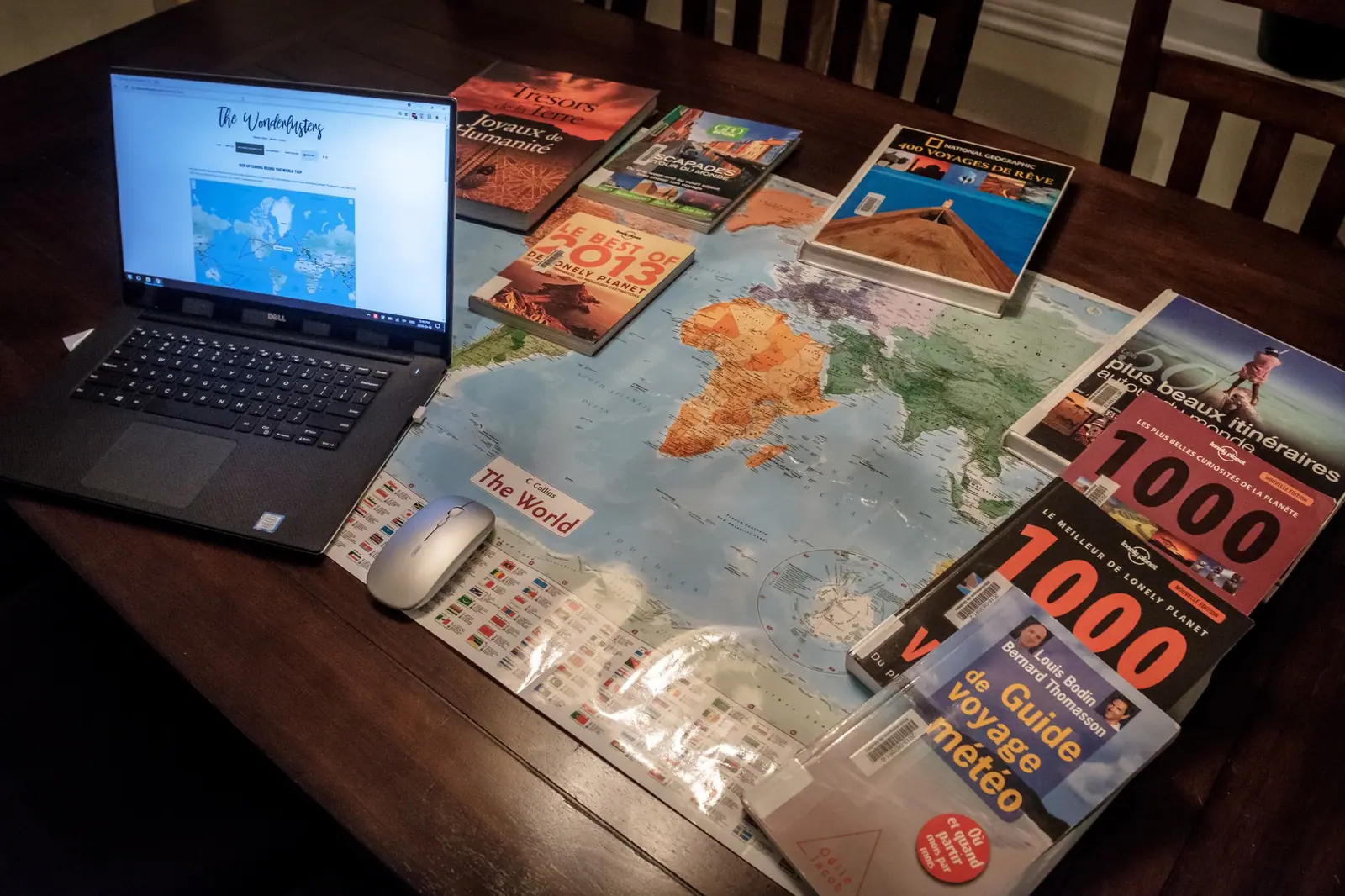
Clearing, in gardening, means cutting back overgrowth so you can see the ground clearly - and that’s exactly what this step does for an itinerary. The first move is to look for inspiration and build a bucket list of places to discover, activities to try and culinary experiences to have, without setting any limits. We considered every continent, revisiting the places we already knew and discovering ones we didn’t, and left nothing off the table.
At this stage, resist the urge to filter anything out for cost, distance or feasibility - that comes later. The goal is simply to end up with a list that reflects everything the whole family is curious about, so nothing gets left behind by accident once the real planning starts.
Sources of Inspiration
As a photography enthusiast, I naturally browsed travel blogs and Instagram, both endless sources of inspiration. But even in the internet age, nothing beat books. The local library was an invaluable resource: we spent hours flipping through travel guides, carefully noting every place we wanted to see.
What We Took Away
This exercise paid off in several ways. We discovered places we didn’t know existed. Places that already fascinated us kept their appeal. Countries we’d never planned on visiting became must-sees, while others we used to dream about became a lot less compelling.
Step 2: Macro Planning - Sketching a Quick Itinerary
Estimating Days Needed per Country
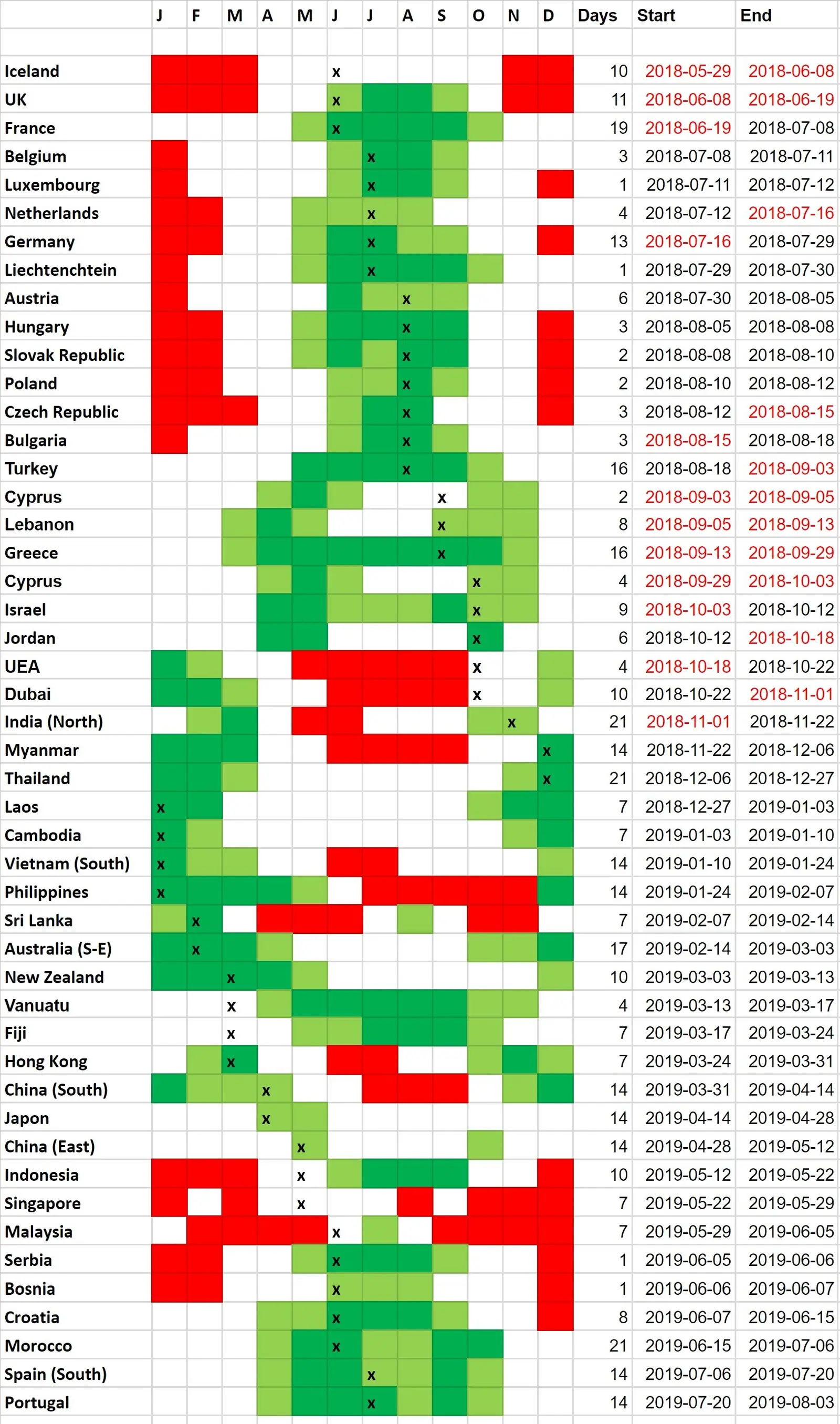
To draft a first version of a proper round-the-world itinerary, I grouped the bucket-list locations by country. For each one, I estimated how many days we’d need to see everything on the list, at a pace the whole family could sustain and enjoy. That estimate factored in the distances to cover, how much there was to see and do, the pace we wanted with the kids, and the cost of living.
This is the step where the bucket list starts turning into a real plan: a rough number of days per country, added up, gives you a first sense of how long the whole trip needs to be and where the time is really going.
Best Months to Visit Each Country
For each country, I identified the best months to visit, weighing temperature, rainfall, tourist crowds and seasonal festivals. Since we live through 8 months of winter a year in Quebec, we wanted to spend the trip chasing the sun. That also let us travel lighter and save on airfare, as I explained in an earlier article.
Sequencing the Countries
From there, it was a matter of ordering the countries by best visiting season and planned length of stay, while grouping neighboring countries as much as possible. The result was a short draft itinerary - the foundation for the more detailed planning to come.
What Our Draft Itinerary Revealed
A few things stood out from this draft:
- Since much of our bucket list was in Asia, and the best time to visit those places falls between November and March, we prioritized that region for those months to avoid the worst of the heat.
- Europe got split in two: part of it at the start of the trip, the rest at the end, since we couldn’t fit our whole European bucket list between June and October.
- We skipped North America, since we’d already covered a lot of it.
- We also skipped South America: its summer falls during the northern hemisphere’s winter, and given how few bucket-list spots we had there, we chose Asia instead.
- The only African country on our list was Morocco. Honestly, no other country on the continent felt safe enough for us at the time, apart from Tanzania and Madagascar - and those two sat far enough off our route that adding them would have strained our budget.
Step 3: Micro Planning - Fine-Tuning the Country Order
Moving from one country to the next comes with its own set of challenges. Several constraints shaped how we ordered our itinerary.
Choosing Transport: Car, Train or Plane
When countries are small and share borders, as in Europe, it’s often easier to cross by car, bus or even boat. Traveling as a family, I’d recommend renting a car: it’s usually cheaper than 4 bus or train tickets, and it gives more flexibility to handle the unexpected. For a solo traveler or a couple, public transport tends to be the better deal, at the cost of some flexibility. To go from one large country to another, or to cross an ocean, we relied on flights.
Airline Ticket Prices
Airfare can vary a lot from one country to another, often depending on major airline hubs. Routing through one of those hubs - London, Istanbul, Singapore, Hong Kong - can save a lot of money, and that shaped how we ordered several legs of the trip.
Car Rental Restrictions in Europe
I originally wanted to rent a car in Paris, Brussels or Amsterdam for a proper road trip across Europe all the way to Greece, dropping the car off there. That plan fell apart once I realized most rentals can’t legally go past Austria: western car rental companies restrict travel into countries outside the European Union, including several former Eastern Bloc countries, and I’d forgotten those borders still existed. Plan B: since flying within Europe is cheap, we booked flights instead and rented cars locally around each airport.
Crossing the Lebanon-Israel Border
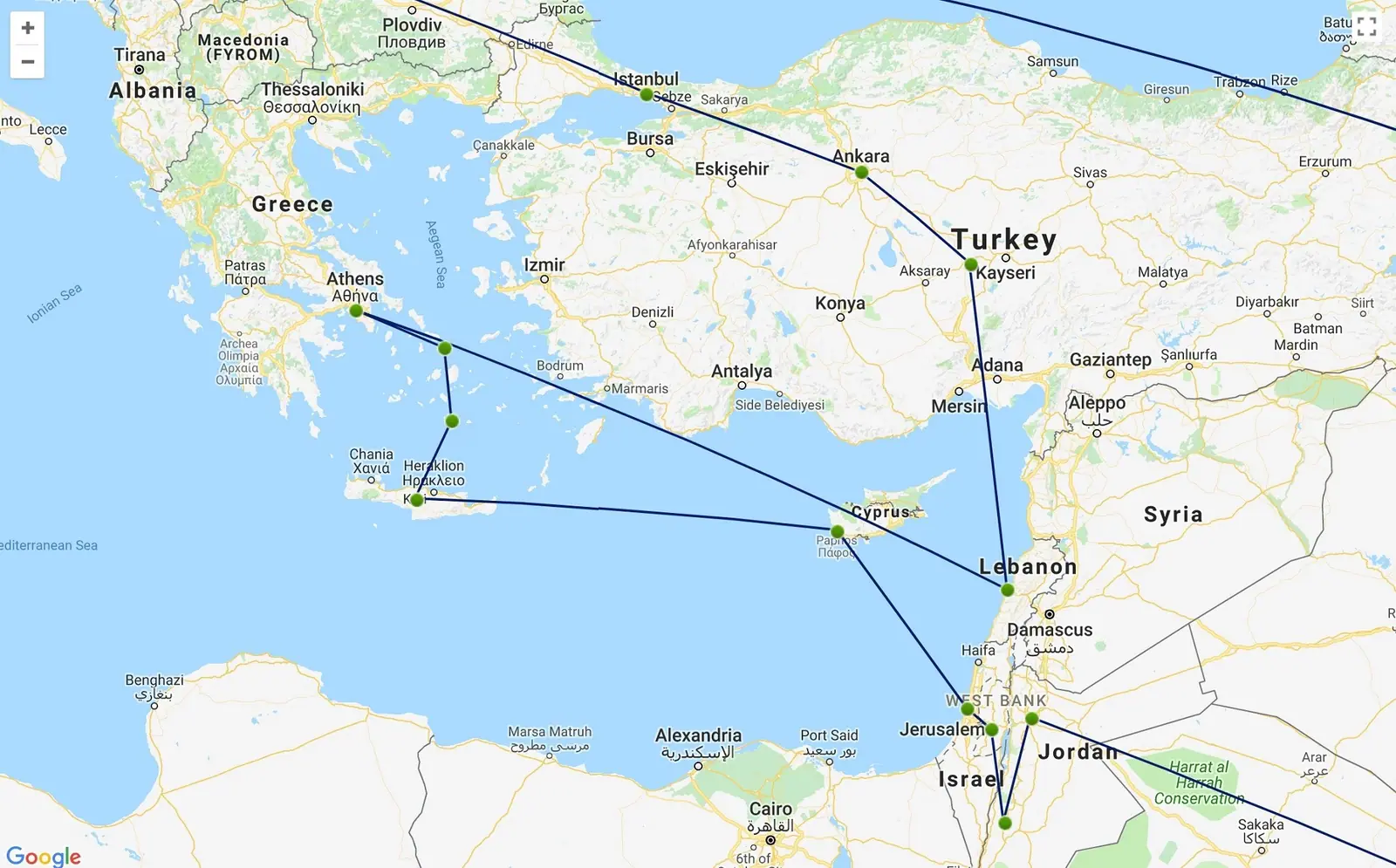
Another challenge was fitting in both Lebanon and Israel, two neighboring countries, on the same trip. It turns out there’s no direct way to travel between them, by land or by air: Lebanon denies entry to anyone with evidence of having visited Israel, which meant planning to visit Lebanon before Israel. Our route: Turkey to Lebanon, then Greece, then Israel by way of a detour through Cyprus. Complicated? You have no idea.
2026 update: the situation has only gotten more serious since we planned this route. The Government of Canada currently advises against all travel to Lebanon because of the volatile security situation in the region (travel.gc.ca); check your government’s current advisories before planning a similar itinerary.
My Plea of Not Guilty
I know it can sound alarming to pack so much into so little time, especially with kids. Anyone who knows me well knows how much I genuinely enjoy this kind of planning, and I promise our children always come first: I never planned anything I didn’t think they could handle. They were already seasoned travelers by then, and having fun together as a family was the whole point.
I also know the goals of a round-the-world trip aren’t the same for everyone. If I’d wanted to fully immerse myself in a single country’s culture, neither a week, nor a month, nor even a year would have been enough. Our goal was never to see every corner of every country, but to experience what mattered most to us - and visiting many countries didn’t stop us from appreciating each one.
If you’re planning your own itinerary, don’t expect to nail the order and the pace on the first pass. Ours shifted more than once as flight prices, seasons and border rules got in the way of the original plan - the three steps above are really just a framework for making those trade-offs deliberately instead of by accident.
Questions travellers ask
What are the three steps to planning a round-the-world itinerary?
We used three steps: clearing (building a bucket list of places and experiences without limits), macro planning (grouping bucket-list spots by country, estimating the days needed and the best season, then sequencing countries into a draft itinerary), and micro planning (fine-tuning the order around transport, airfare, car rental rules and border constraints).
How do you decide which countries to prioritize on a round-the-world trip?
We matched each country's best visiting season to our route - for example, we scheduled Asia for November to March to avoid the heat, and split our time in Europe between the start and end of the trip to fit it between June and October.
Is it cheaper to rent a car or use public transport for a family trip in Europe?
For a family, renting a car is usually cheaper than buying separate bus or train tickets and gives more flexibility; solo travelers or couples tend to save more with public transport instead.
Can you visit Lebanon and Israel on the same trip?
There is no direct way to travel between Lebanon and Israel: Lebanon denies entry to travelers with evidence of having visited Israel. Our route went through Turkey to Lebanon, then Greece, then Cyprus to reach Israel. As of 2026, official travel advisories recommend against all travel to Lebanon.
Why can't you rent a car across all of Europe?
Western car rental companies restrict travel into countries outside the European Union, including several former Eastern Bloc countries, which limits how far east a rental car can go.